 Free
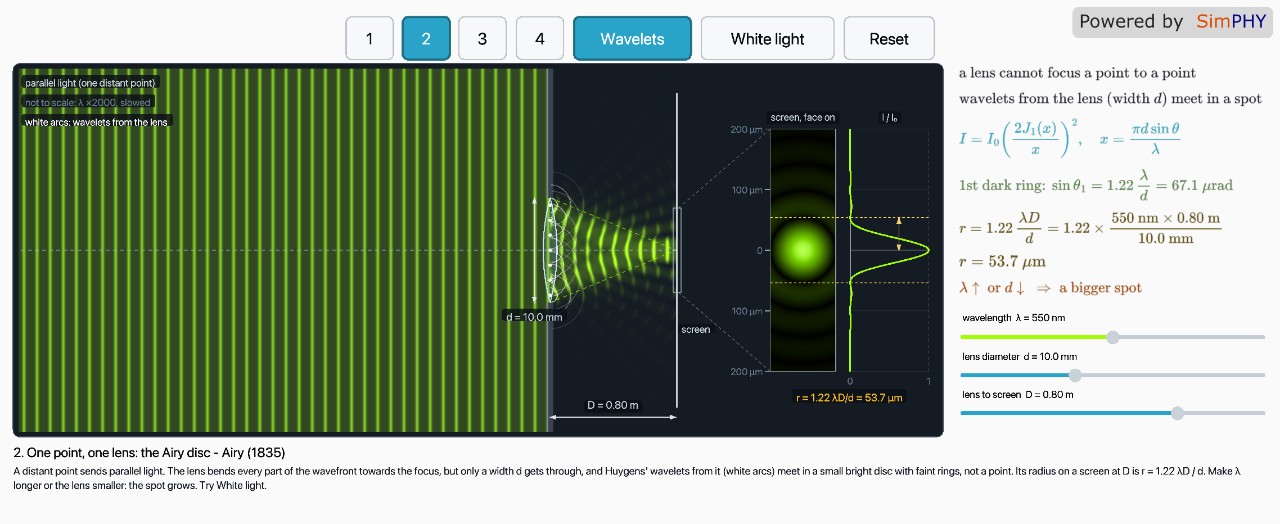
Rayleigh Criterion and Lens Resolution
Wave OpticsVisualize diffraction’s Airy pattern and apply Rayleigh’s criterion to...
Explore Huygens' principle by building wavefronts from wavelets, adjusting source distance and number of…
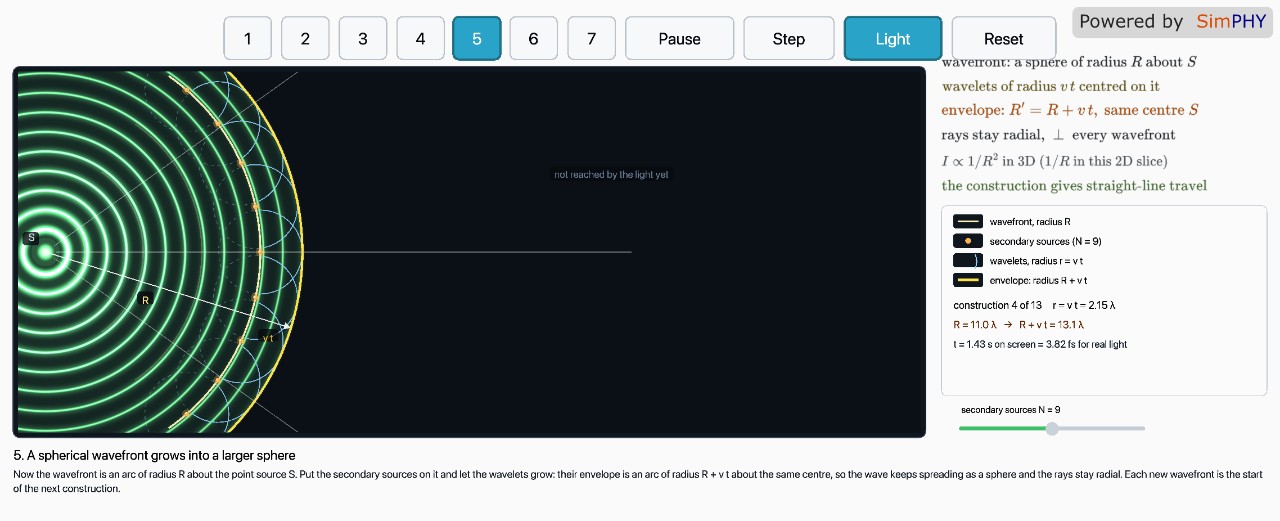
Huygens' principle states that every point on a wavefront acts as a source of secondary spherical wavelets, and the new wavefront is the envelope of these wavelets. This simulation visualizes the construction of wavefronts, the growth of secondary wavelets, and the resulting envelope, linking the concept to Fermat's principle of least time and the Fresnel‑Kirchhoff obliquity factor.
Students can step through the construction process using numbered step buttons, play or pause the animation, and finish a single construction step. Sliders let them change the source distance, the number of secondary sources (particles), and the width of an opening. Additional toggles switch the light field rendering on or off and enable the obliquity correction.
By interacting with the model, learners observe how wavefronts evolve, how diffraction patterns arise from different apertures, and how the number of secondary sources influences the smoothness of the wavefront. The activity reinforces concepts of wave propagation, diffraction, and the wave‑optics description of light.
Free
Visualize diffraction’s Airy pattern and apply Rayleigh’s criterion to...
 Free
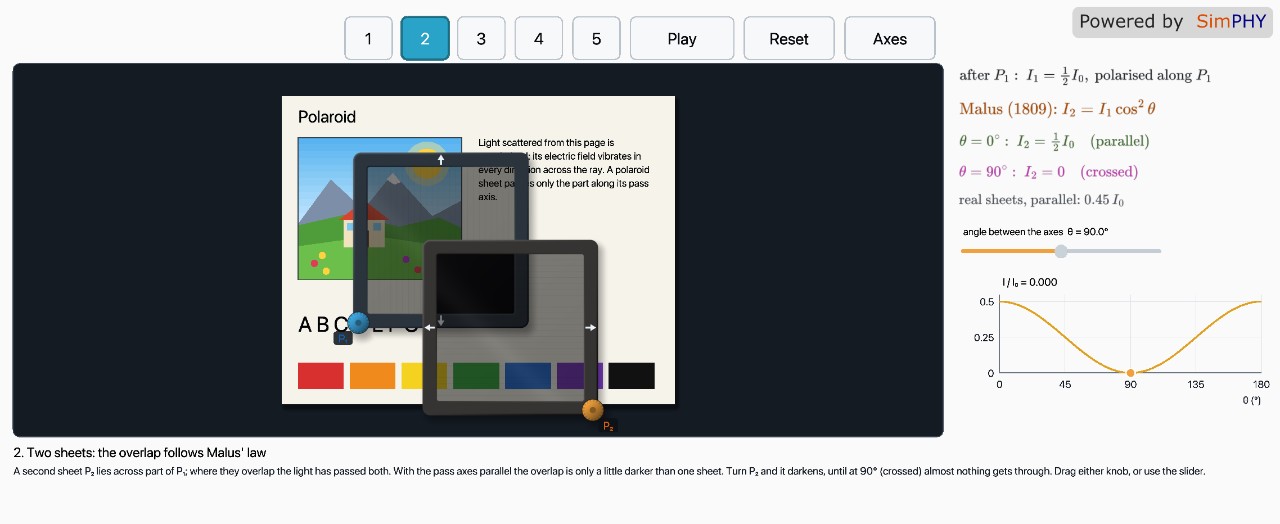
Explore how polarising filters change light intensity, test Malus’ law...
 Free
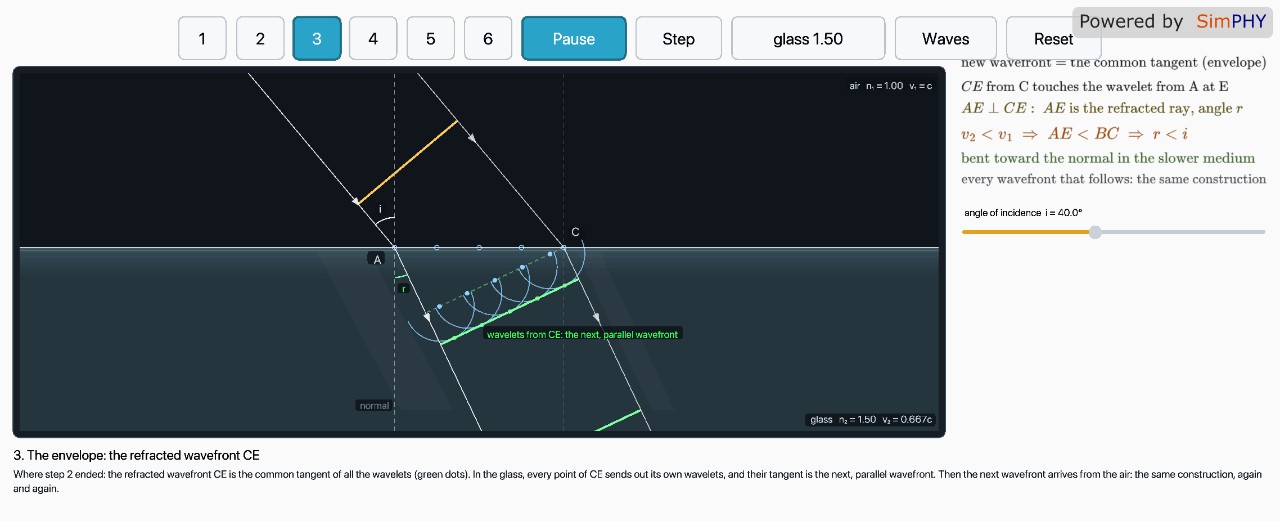
Step through Huygens' principle to watch wavefronts refract, derive Sn...
 Free
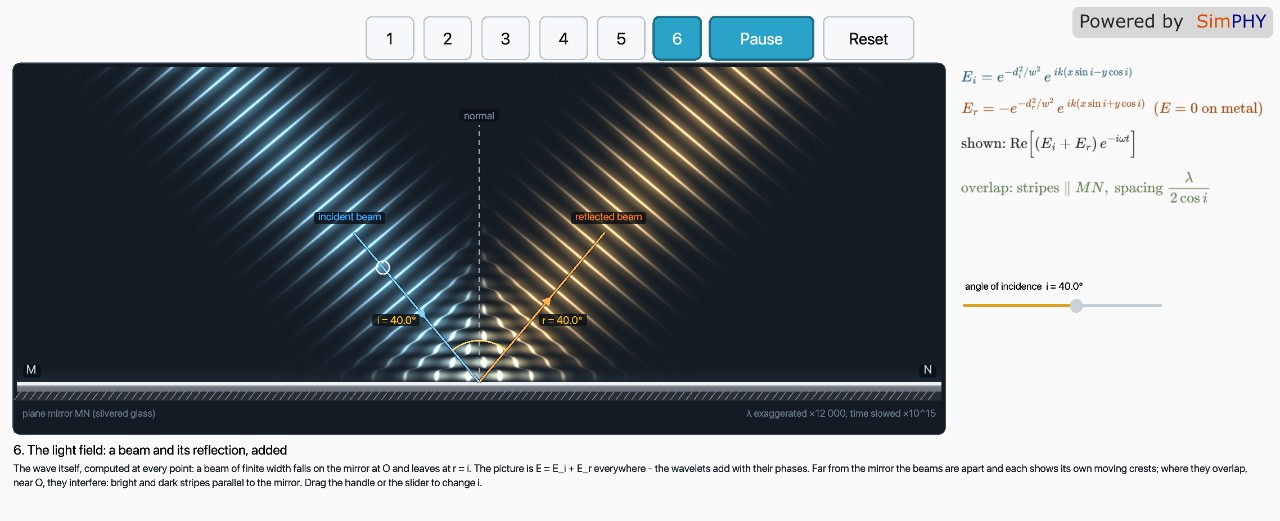
Interactive proof of the law of reflection via Huygens’ principle, wit...
 Free
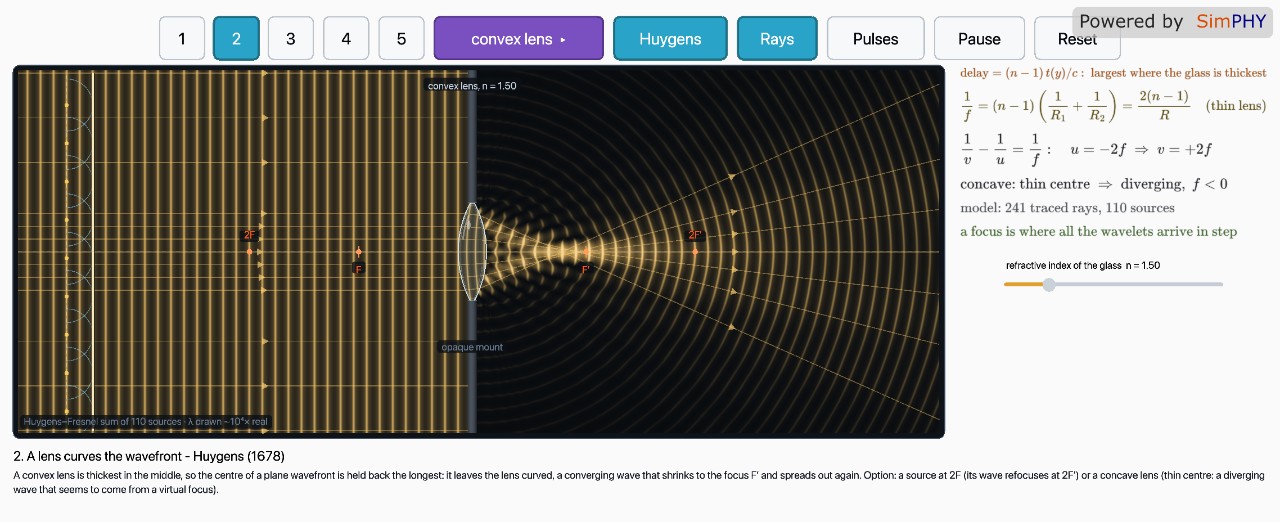
Explore Huygens’ construction and ray behavior as wavefronts pass thro...
 Free
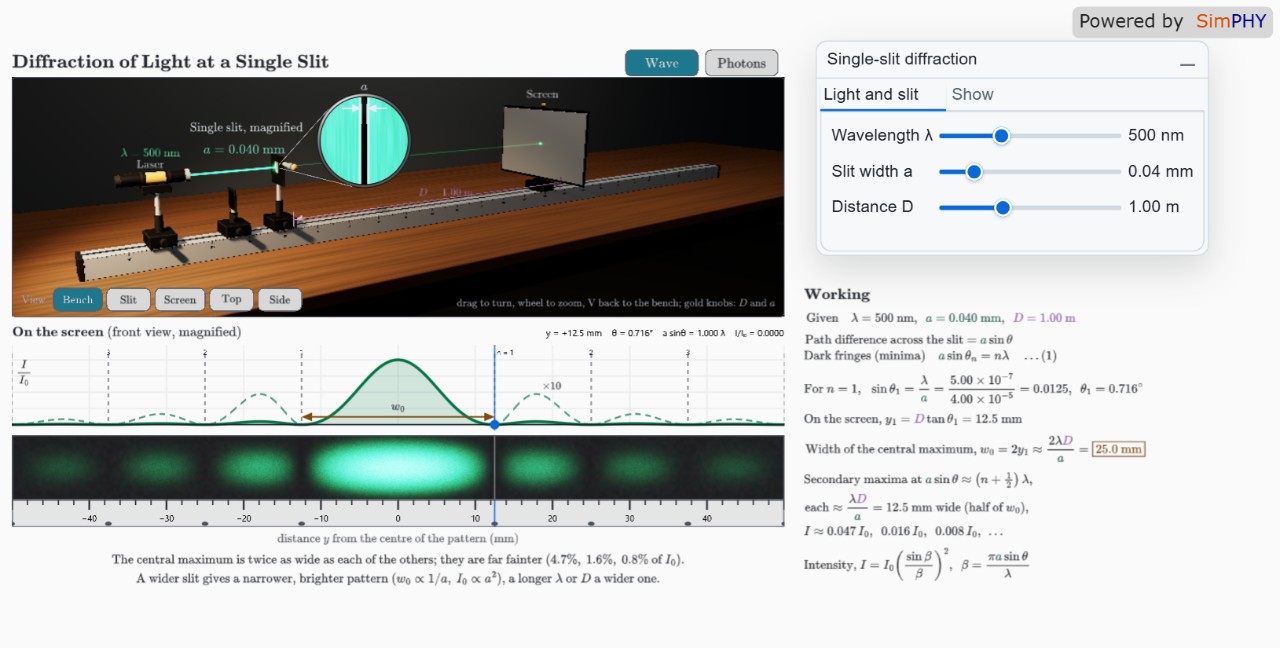
Explore how slit width, wavelength, and distance affect the Fraunhofer...