 Free
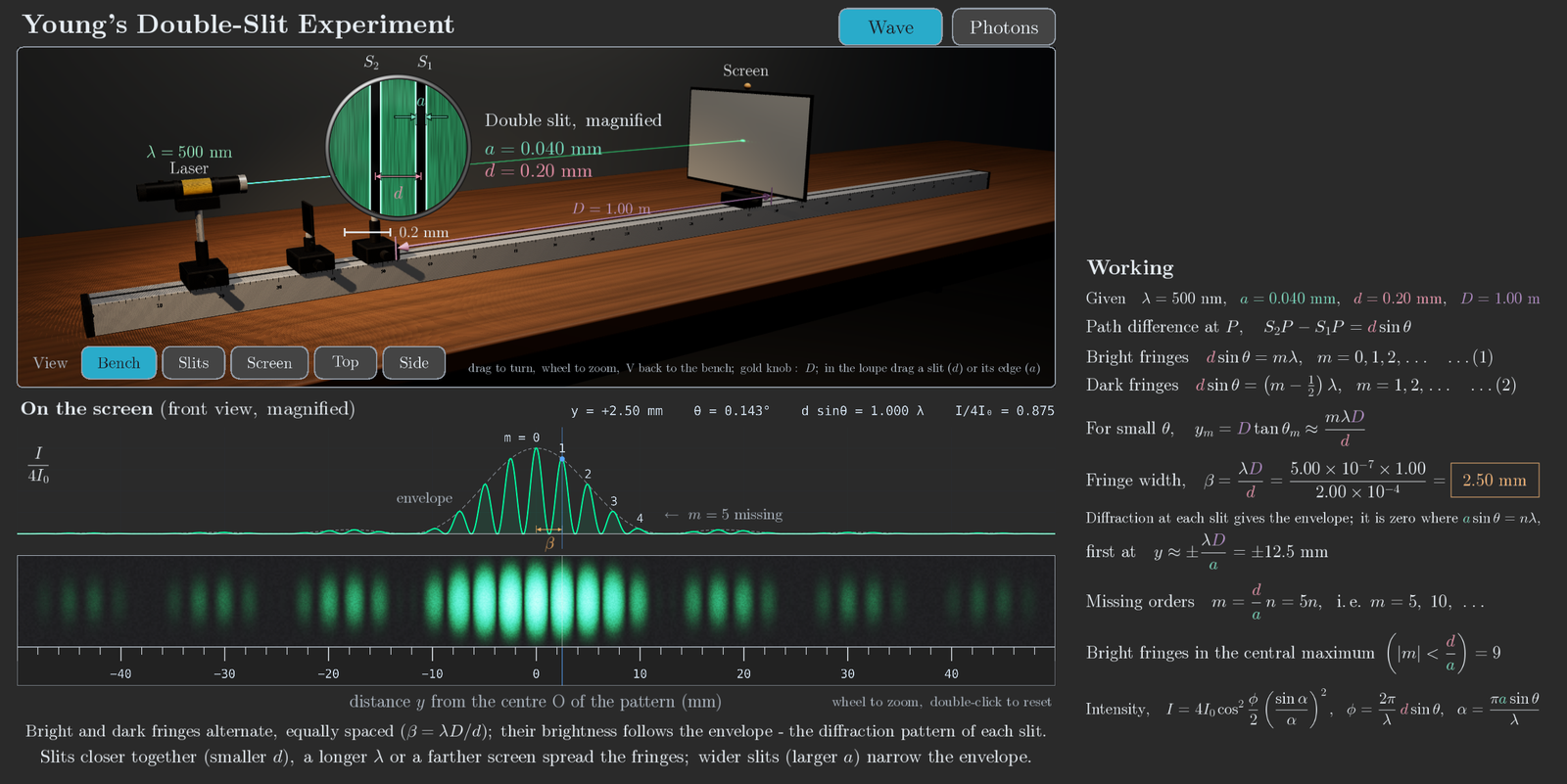
Young's Double‑Slit Experiment
Wave OpticsObserve interference and diffraction from a laser through adjustable s...
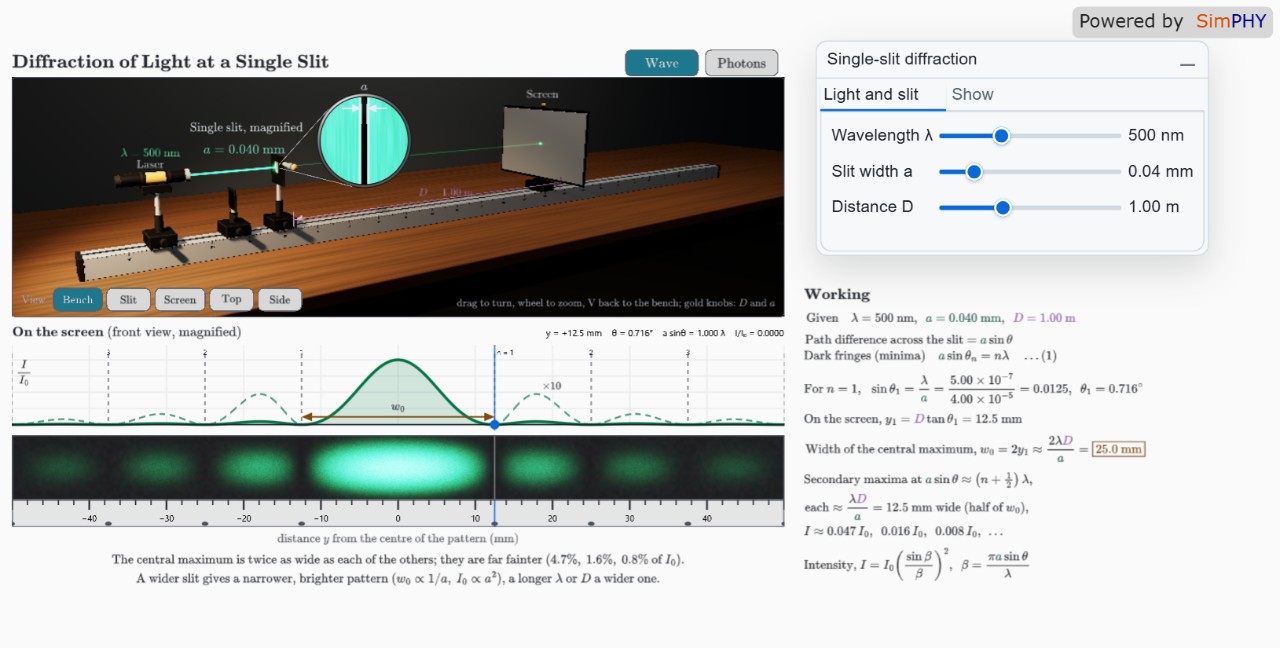
Explore how slit width, wavelength, and distance affect the Fraunhofer diffraction pattern of a laser beam.
The simulation shows Fraunhofer diffraction from a single rectangular slit. The intensity distribution follows I=I₀(sinβ/β)² with β=πa sinθ/λ, producing a bright central maximum and successive dark and bright fringes whose positions depend on slit width a, wavelength λ and screen distance D.
Students can change the laser wavelength (380–750 nm), the slit width (0.01–0.20 mm) and the distance to the screen (0.5–2.0 m) using on‑screen controls. They can view the full 3‑D bench, a close‑up of the slit, or the screen’s intensity graph, and switch between a continuous‑wave view and a photon‑by‑photon build‑up.
By observing how the fringe spacing narrows as the slit widens, how longer wavelengths broaden the pattern, and how the central maximum’s brightness scales with a², learners connect the mathematical description to real‑world optical behavior and reinforce concepts of wave interference and wave‑particle duality.
Free
Observe interference and diffraction from a laser through adjustable s...
 Free
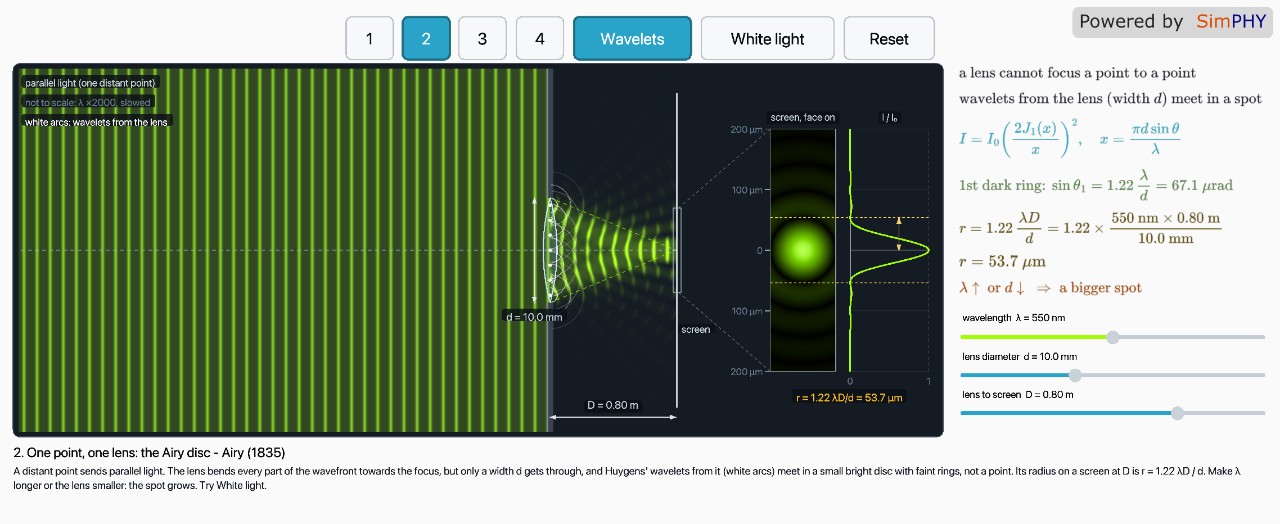
Visualize diffraction’s Airy pattern and apply Rayleigh’s criterion to...
 Free
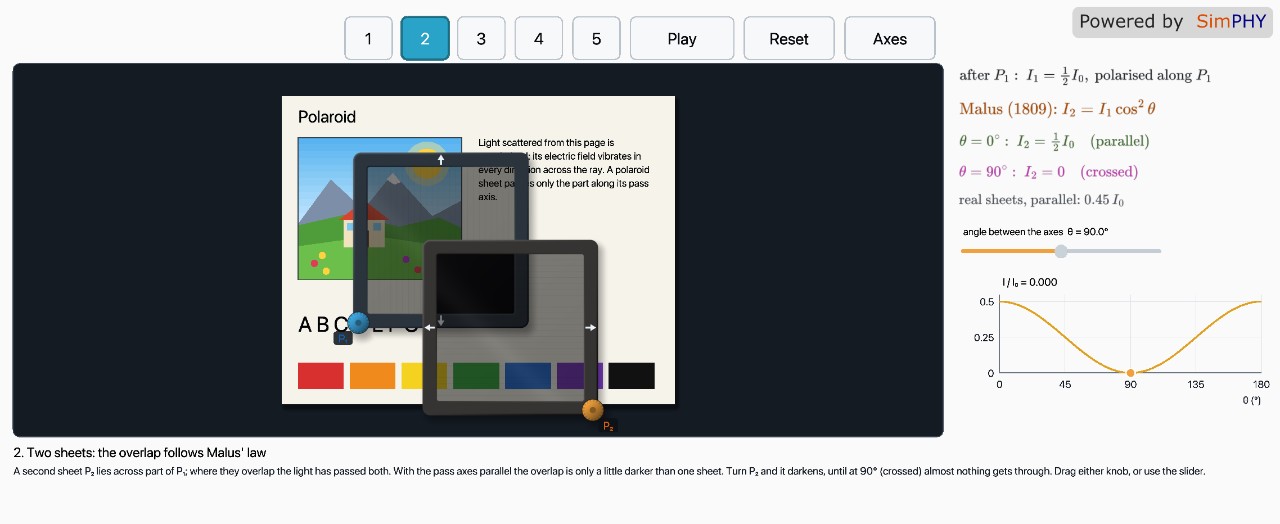
Explore how polarising filters change light intensity, test Malus’ law...
 Free
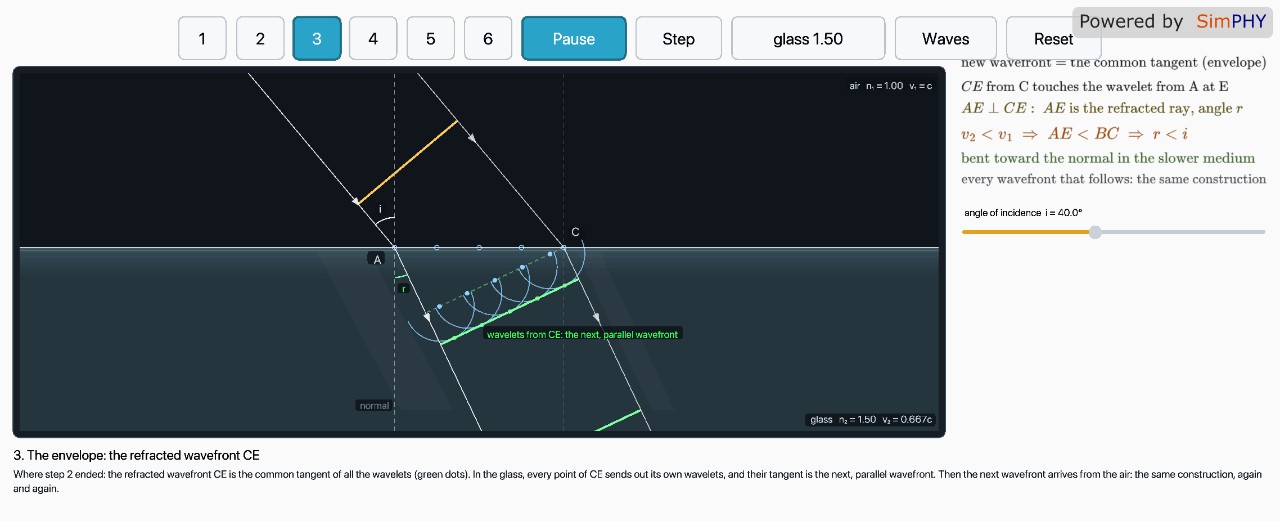
Step through Huygens' principle to watch wavefronts refract, derive Sn...
 Free
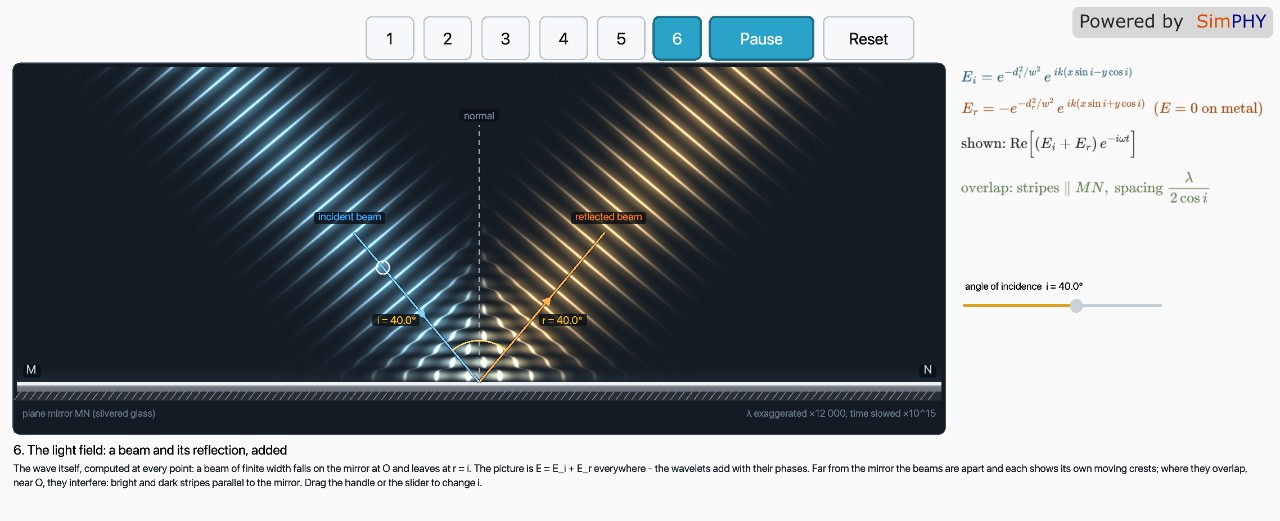
Interactive proof of the law of reflection via Huygens’ principle, wit...
 Free
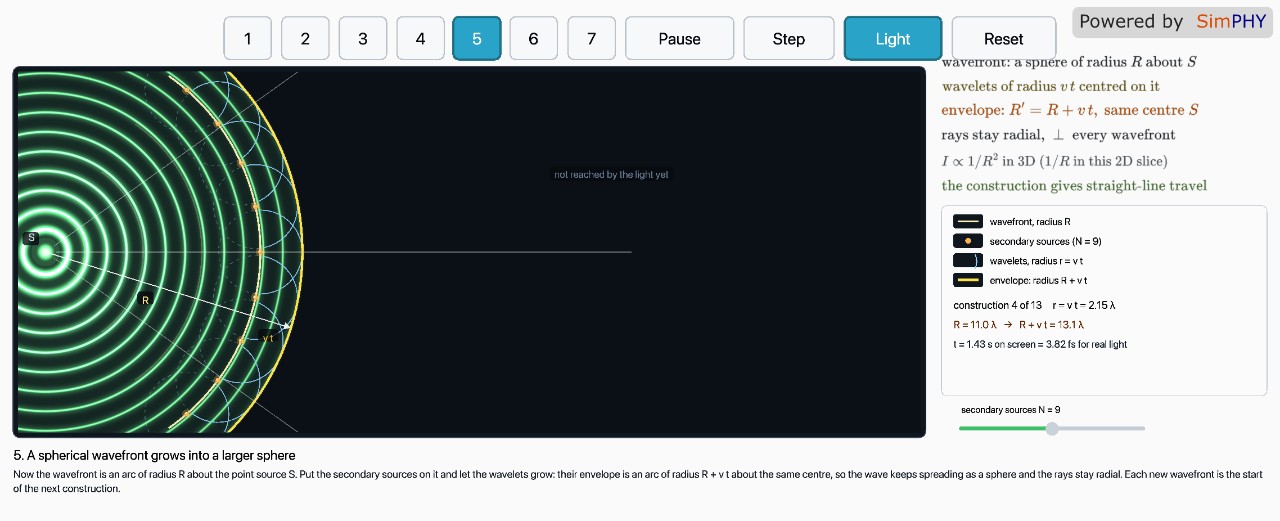
Explore Huygens' principle by building wavefronts from wavelets, adjus...