 Free
Resonance Demonstration
Waves & OscillationsExplore standing wave formation and resonance in a rope with free or f...
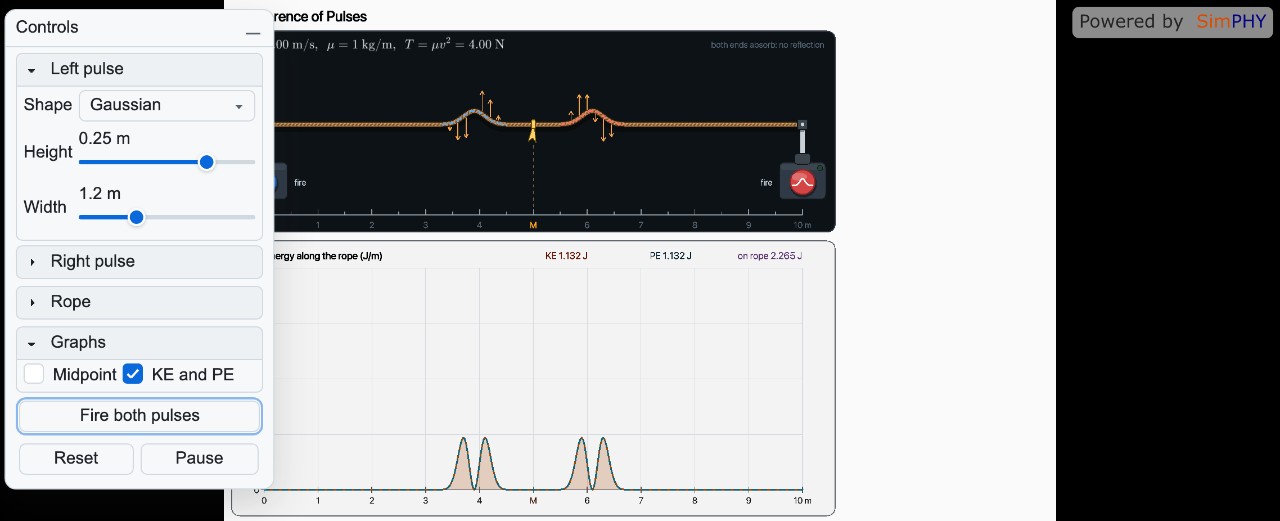
Explore how two opposite‑direction pulses on a rope superpose, using shapes, heights, widths and speed.
Two short pulses travel toward each other on a taut rope. When they meet, the rope’s displacement is the sum of the individual pulse shapes, illustrating the principle of superposition. The wave speed is given by v = √(T/μ), linking tension and linear mass density.
Students can choose each pulse’s shape (Gaussian, triangle, half‑sine, full‑sine, square), its height (positive or negative) and its width, as well as the overall wave speed, simulation speed, and visual view (realistic rope or particle links). Buttons let them fire a pulse from the left, right, or both ends simultaneously, and the far end absorbs pulses without reflection.
By varying these parameters, learners observe how pulse shape and amplitude affect the interference pattern, confirm that pulses emerge unchanged after crossing, and connect the mathematical description y(x,t)=yL(x‑vt)+yR(x+vt) to the visual behaviour of waves on a string.
Free
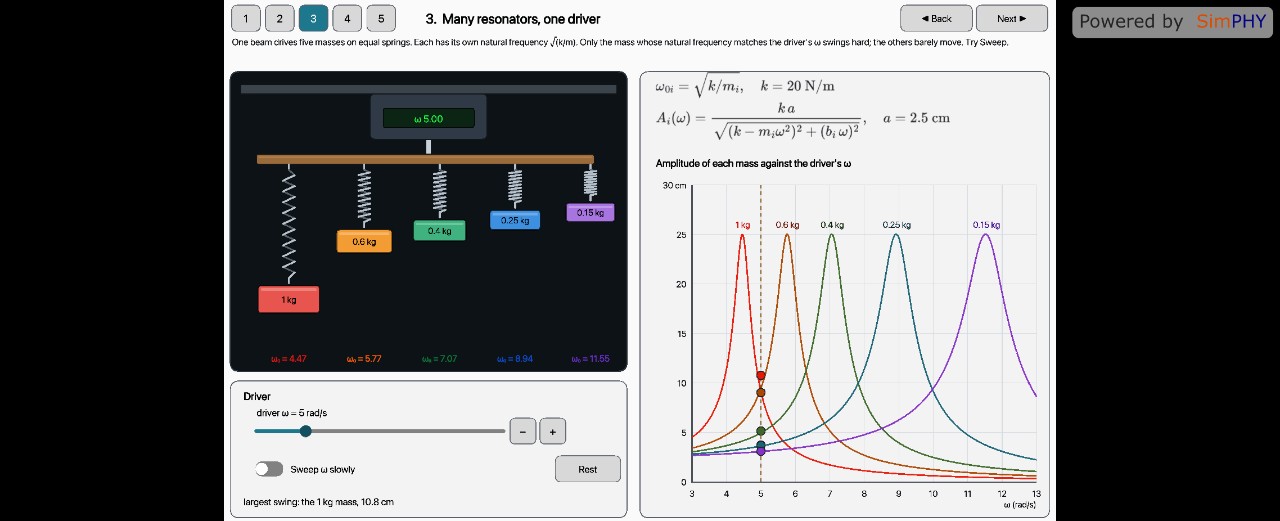
Explore standing wave formation and resonance in a rope with free or f...
 Free
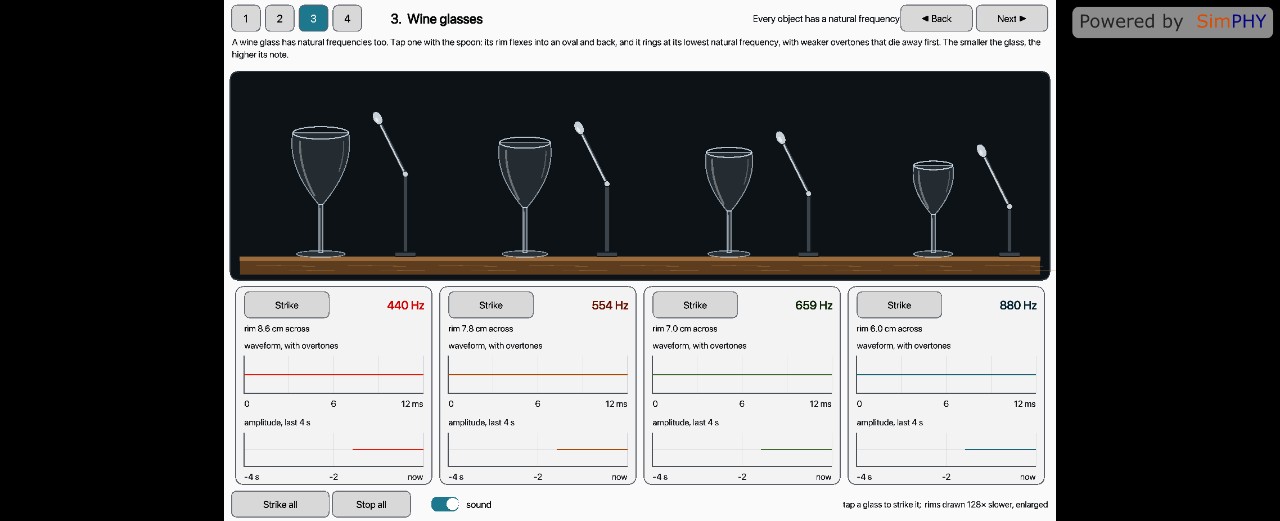
Explore how objects vibrate at their natural frequencies, from springs...
 Free
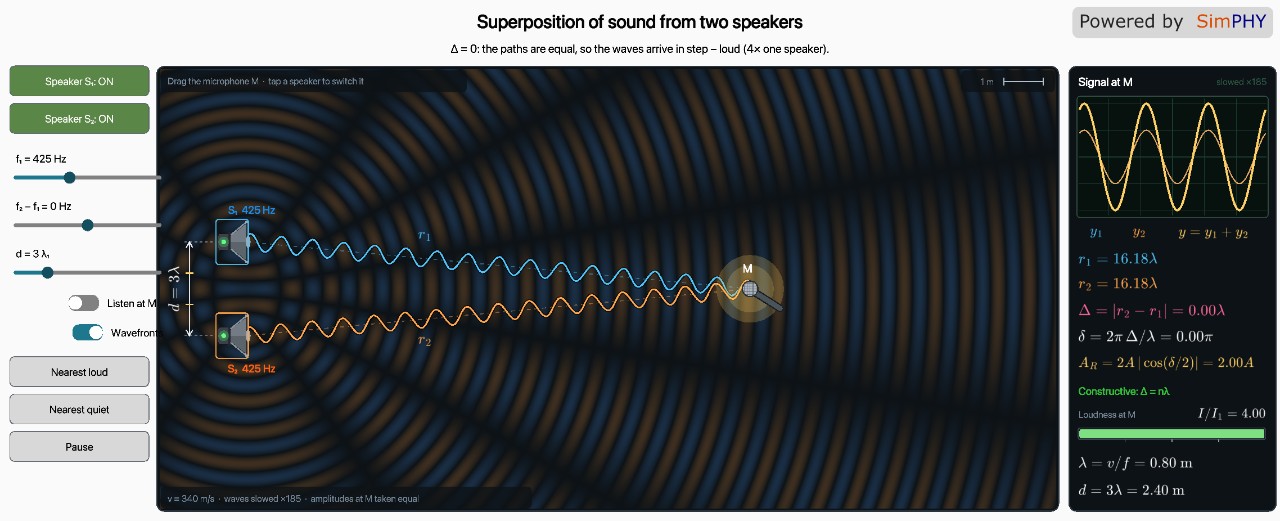
Explore interference and beats from two speakers by adjusting frequenc...
 Free
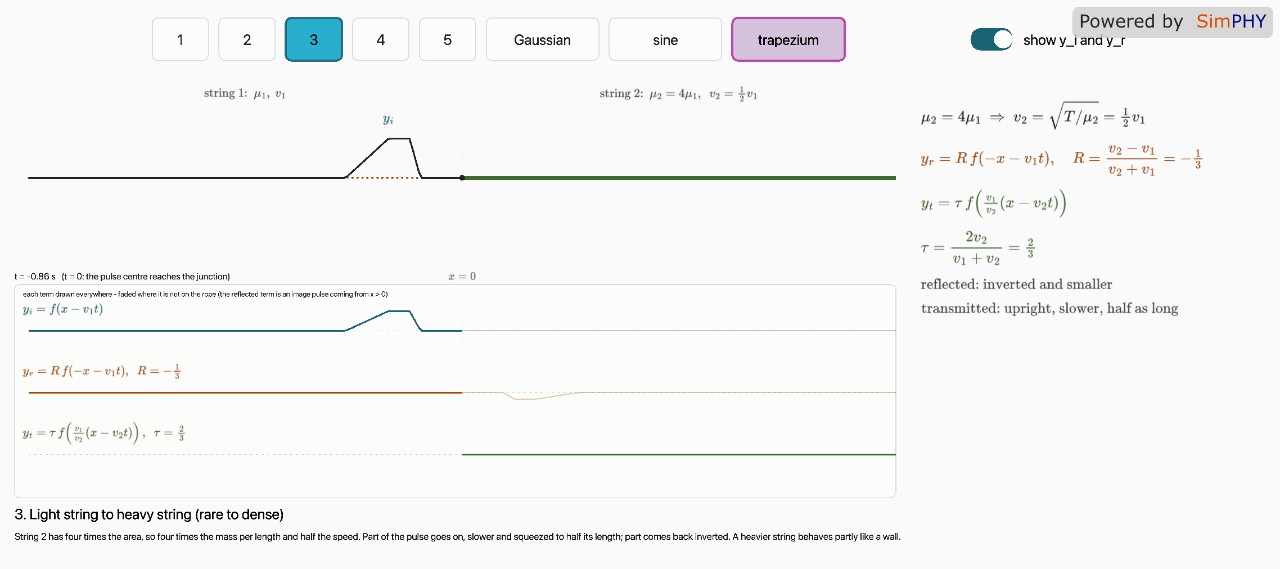
Explore pulse reflection and transmission at fixed, free, and joint st...
 Free
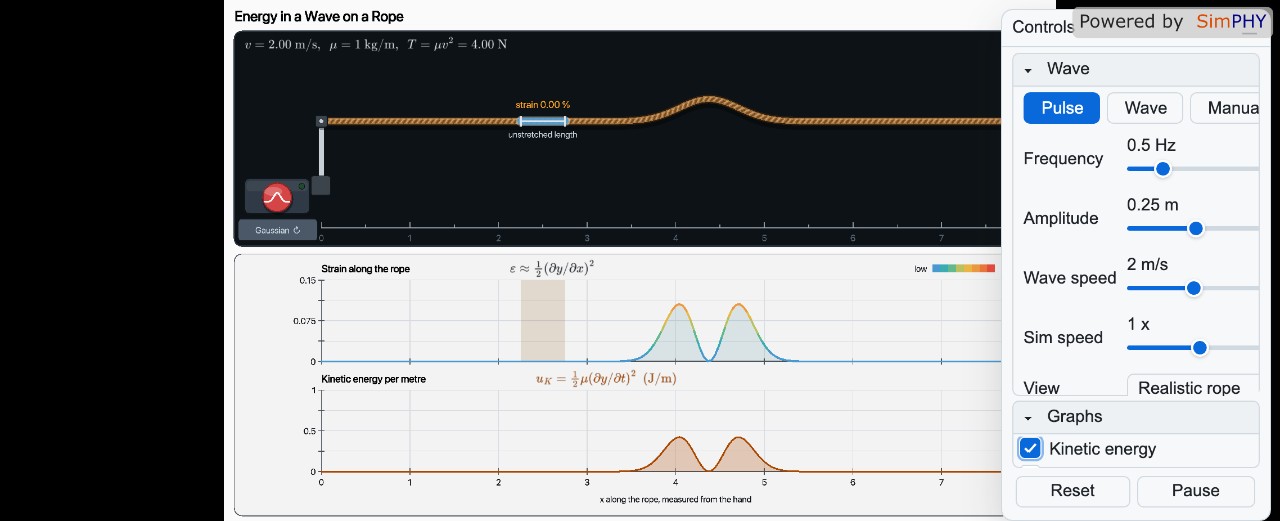
Explore how wave speed, frequency and amplitude affect strain and tota...
 Free
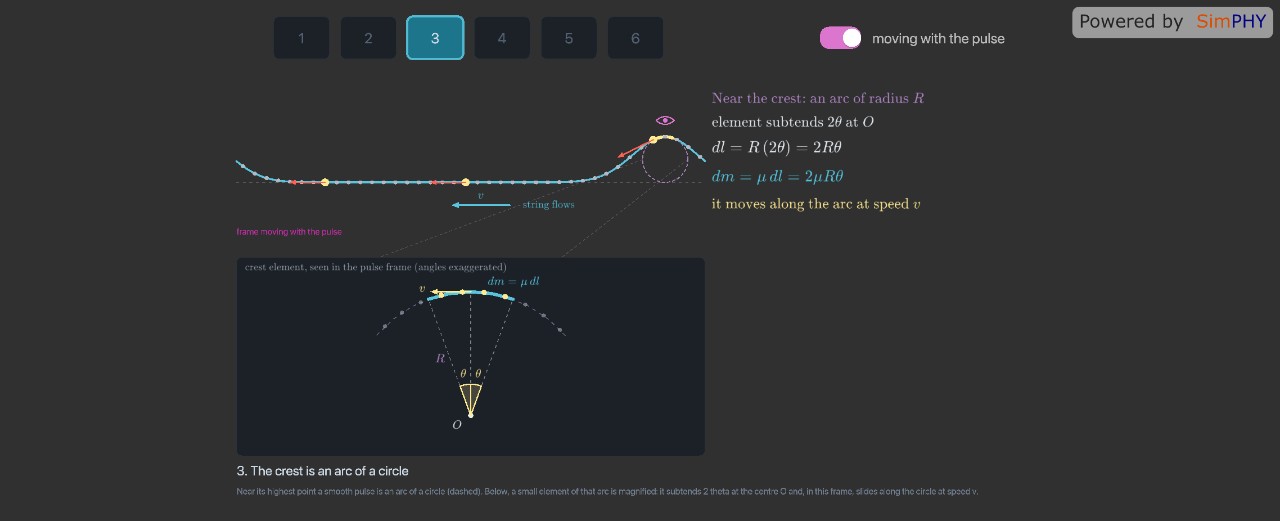
Derive the wave speed v = √(T/μ) on a stretched string, switching betw...