 Free
Resonance Demonstration
Waves & OscillationsExplore standing wave formation and resonance in a rope with free or f...
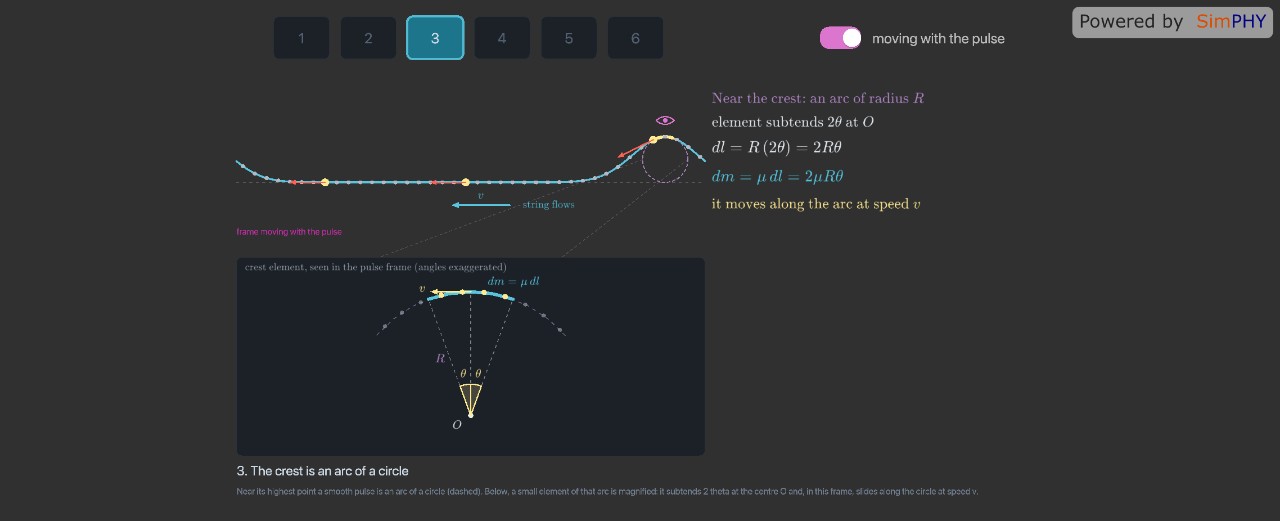
Derive the wave speed v = √(T/μ) on a stretched string, switching between lab and pulse frames step‑by‑step.
This simulation walks students through the classic derivation of the transverse wave speed on a stretched string, v = √(T/μ). Starting from a moving pulse, it shows how tension T and linear mass density μ determine the propagation speed, using geometric arguments about a small arc of the string near the crest.
In the interactive scene, a row of numbered step buttons lets users advance through six symbolic steps. A switch toggles the view between the laboratory frame and the frame moving with the pulse, letting students see how the string material flows past a stationary pulse. Arrow keys provide quick navigation. The visualisation displays the string, tension forces, and the curvature that produces the centripetal force.
By comparing the two frames, learners discover why the same tension produces the same force balance, reinforcing concepts of inertial frames, vector components of tension, and the origin of the √(T/μ) relationship. The activity deepens understanding of wave mechanics and the role of tension and mass density in oscillatory systems.
Free
Explore standing wave formation and resonance in a rope with free or f...
 Free
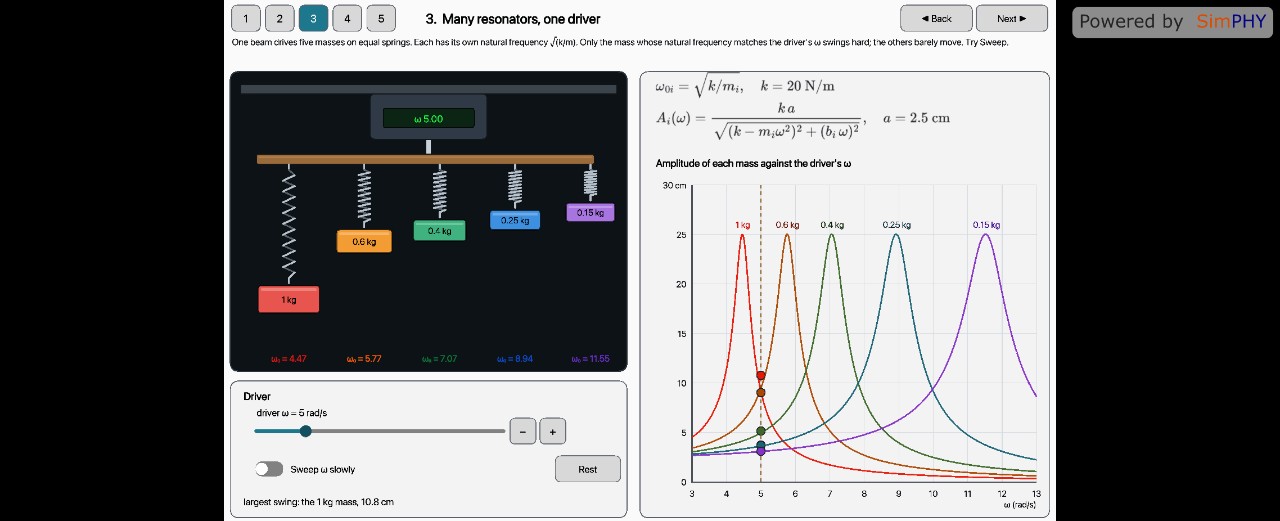
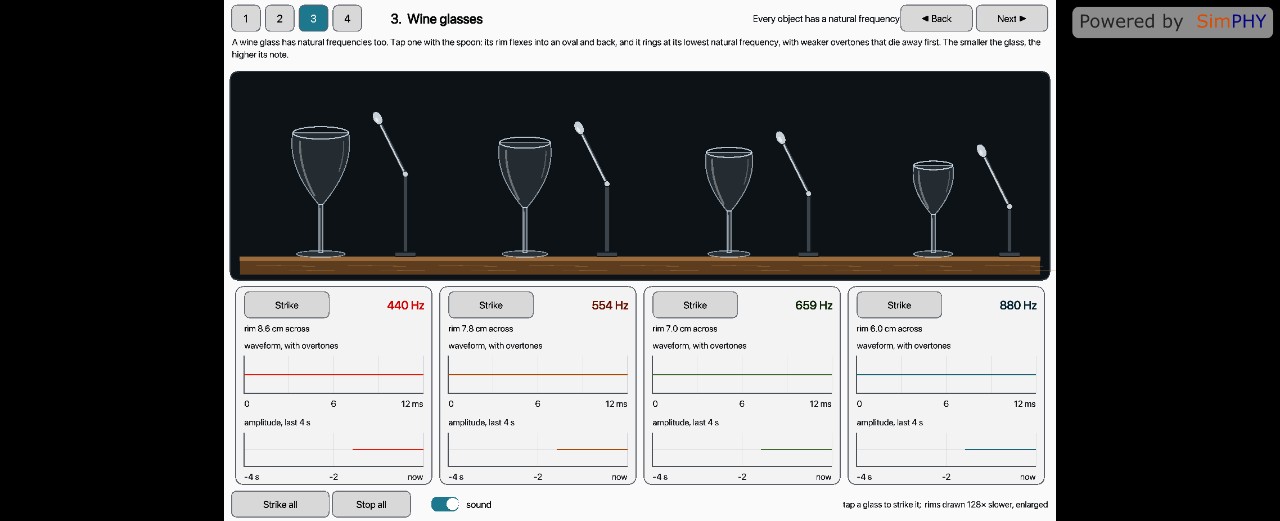
Explore how objects vibrate at their natural frequencies, from springs...
 Free
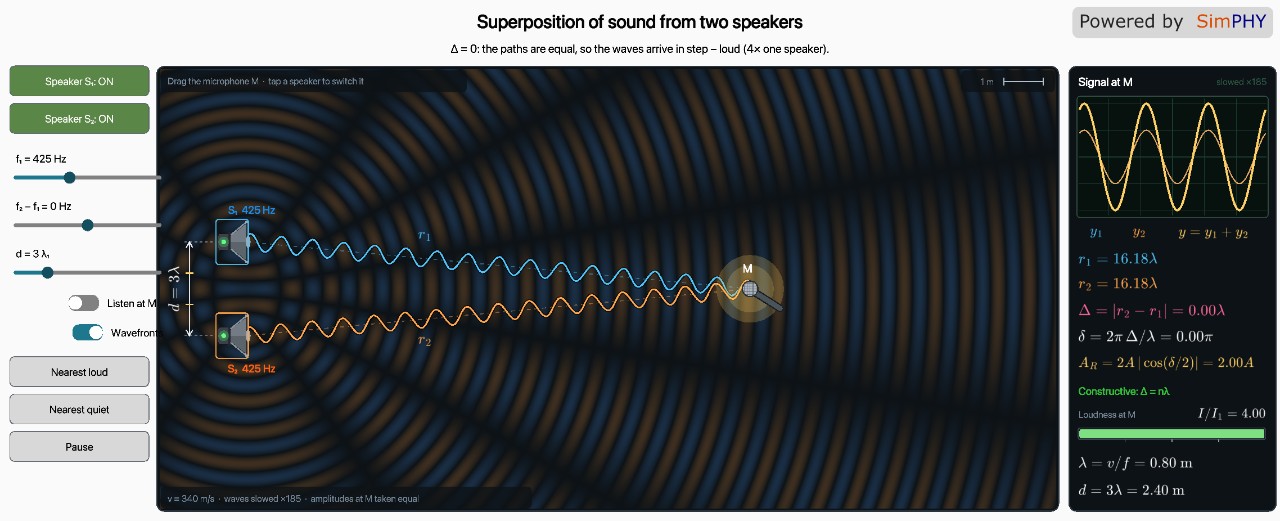
Explore interference and beats from two speakers by adjusting frequenc...
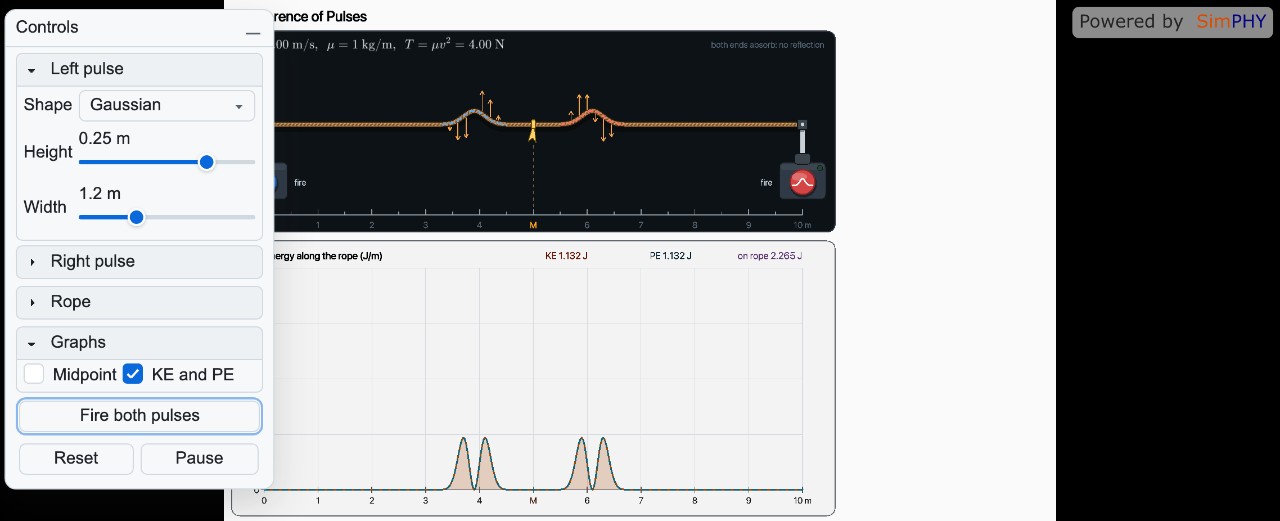 Free
Explore how two opposite‑direction pulses on a rope superpose, using s...
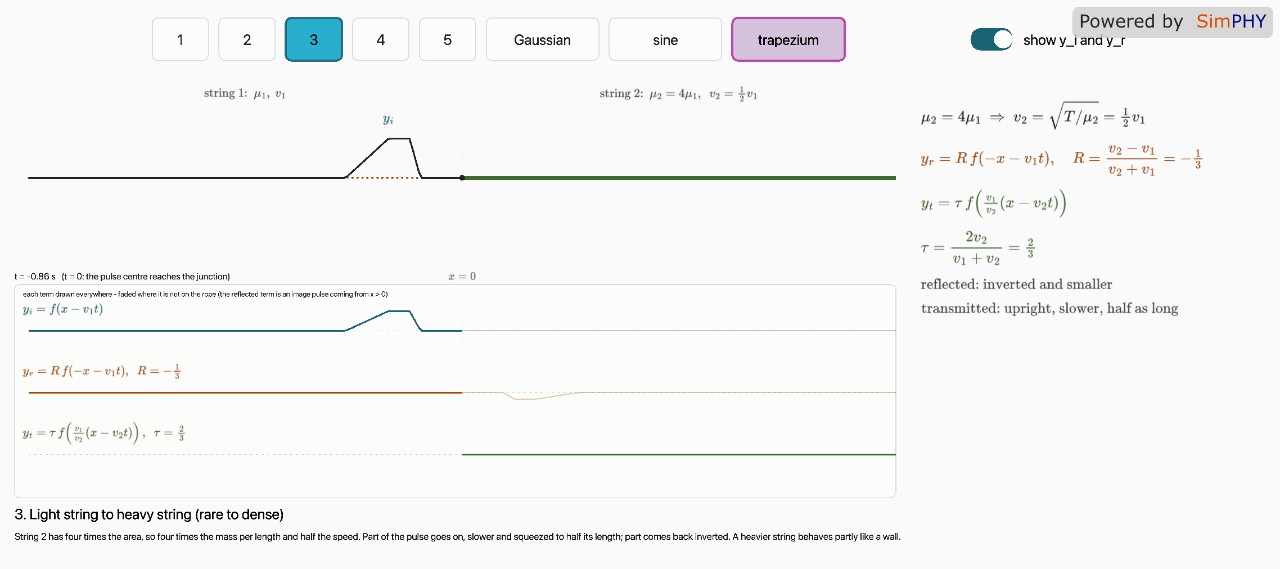 Free
Explore pulse reflection and transmission at fixed, free, and joint st...
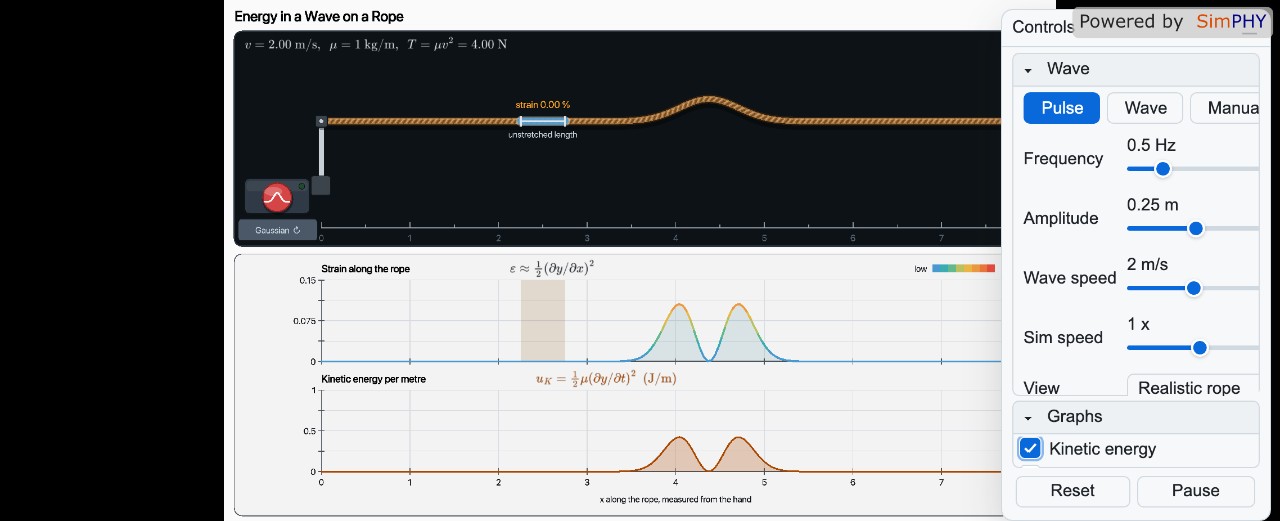 Free
Explore how wave speed, frequency and amplitude affect strain and tota...