 Free
Resonance Demonstration
Waves & OscillationsExplore standing wave formation and resonance in a rope with free or f...
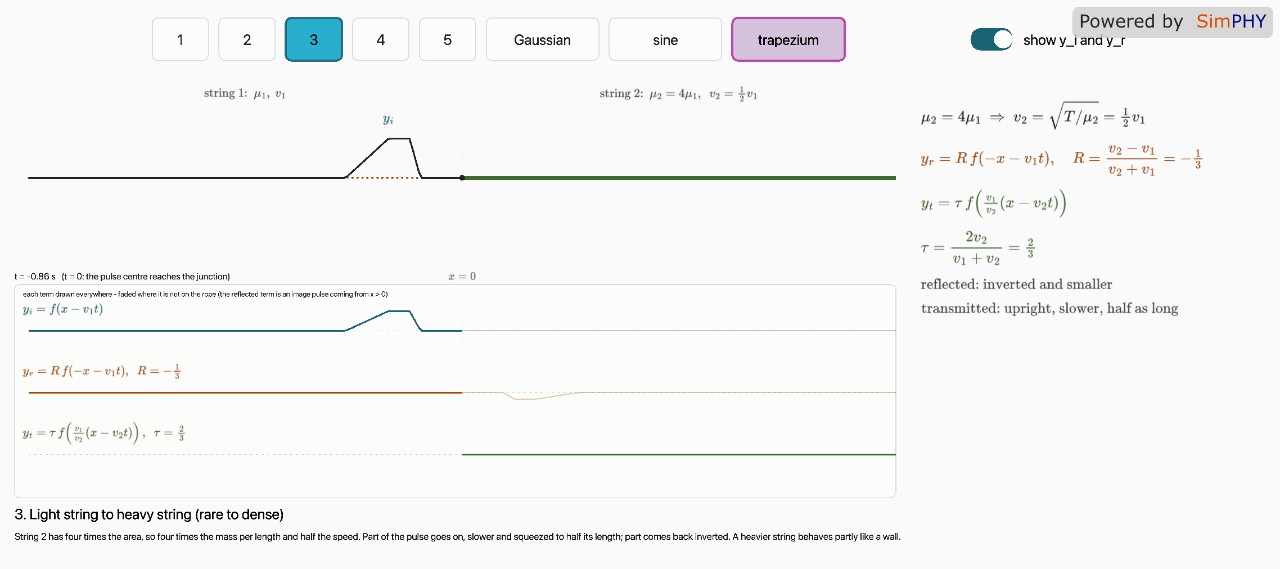
Explore pulse reflection and transmission at fixed, free, and joint string ends, adjusting shape and…
A pulse traveling along a stretched string encounters different terminations: a fixed end, a free end, and a junction to a second string with a different linear mass density. The simulation shows how the incident pulse splits into reflected and transmitted parts, with amplitudes given by the reflection (R) and transmission (τ) coefficients derived from continuity and slope conditions. The speed in each string depends on the tension and mass per length (v=√(T/μ)).
Students step through the demonstration using numbered buttons, select pulse shapes (Gaussian, sine, trapezium), and toggle a switch to view incident and reflected components separately. In step 5 a slider adjusts the ratio μ2/μ1, changing the impedance mismatch and thus the size and phase of reflected and transmitted pulses. Observing the trapezium shape makes the reversal of the reflected pulse evident.
Through this activity learners see how boundary conditions affect wave behavior, how impedance influences reflection and transmission, and how energy is conserved across the junction. The simulation reinforces concepts of wave speed, superposition, and the mathematical form of reflected and transmitted pulses.
Free
Explore standing wave formation and resonance in a rope with free or f...
 Free
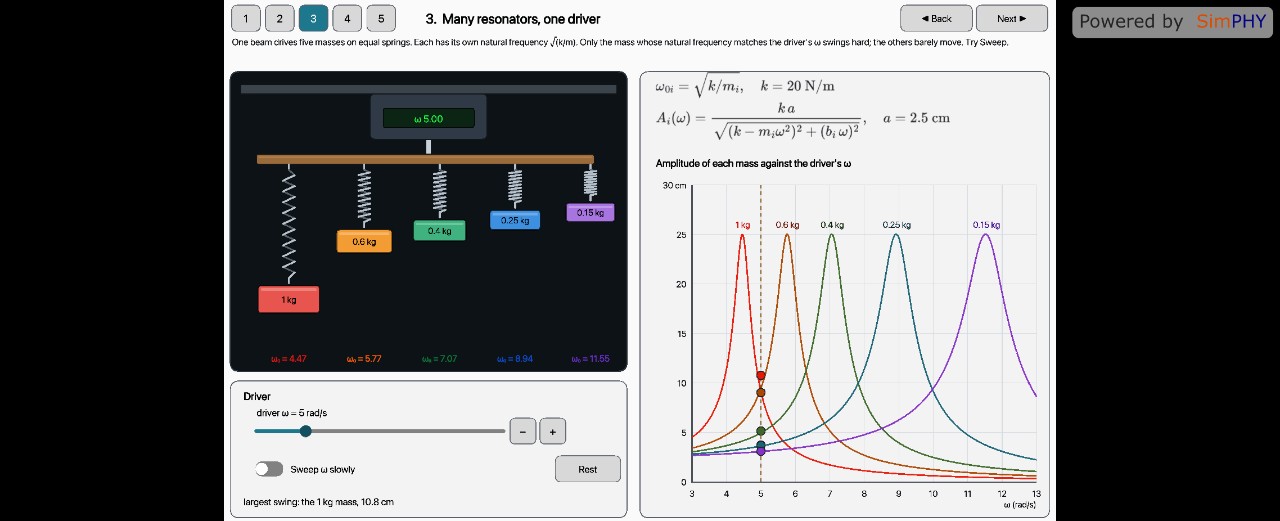
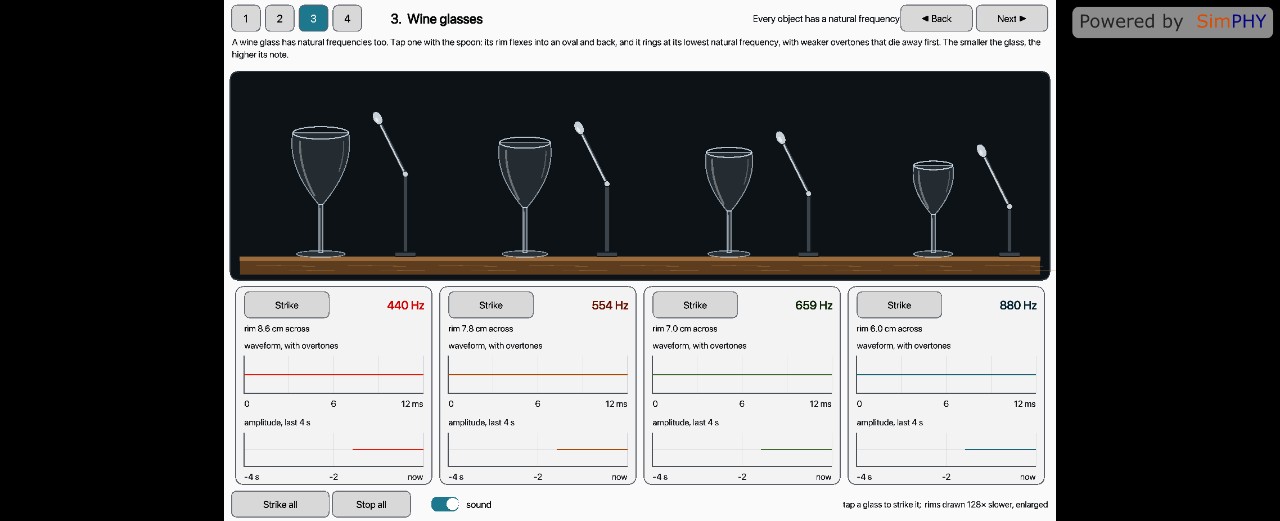
Explore how objects vibrate at their natural frequencies, from springs...
 Free
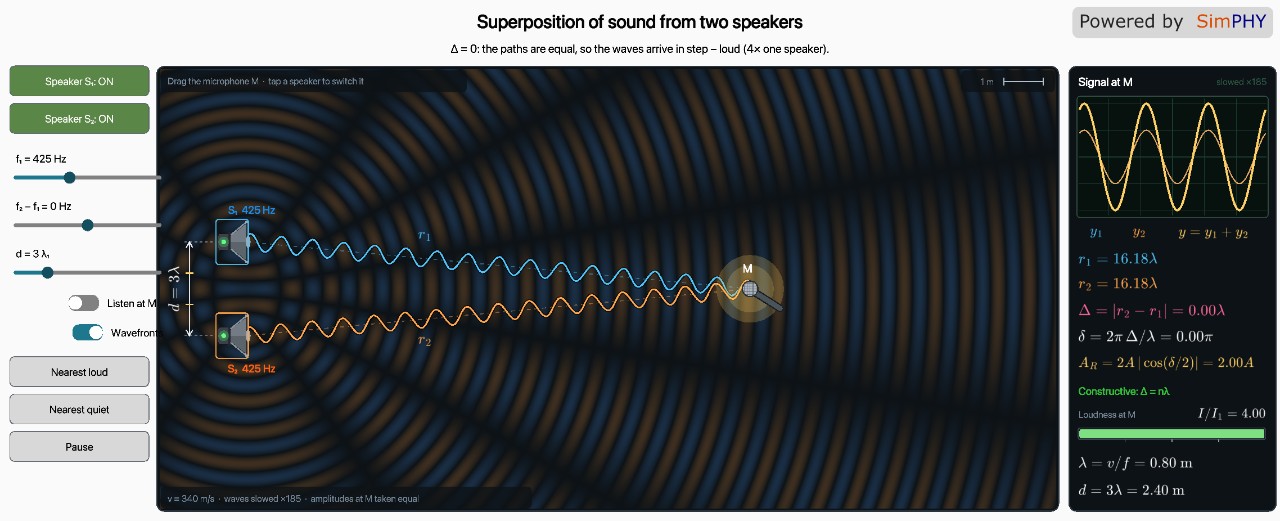
Explore interference and beats from two speakers by adjusting frequenc...
 Free
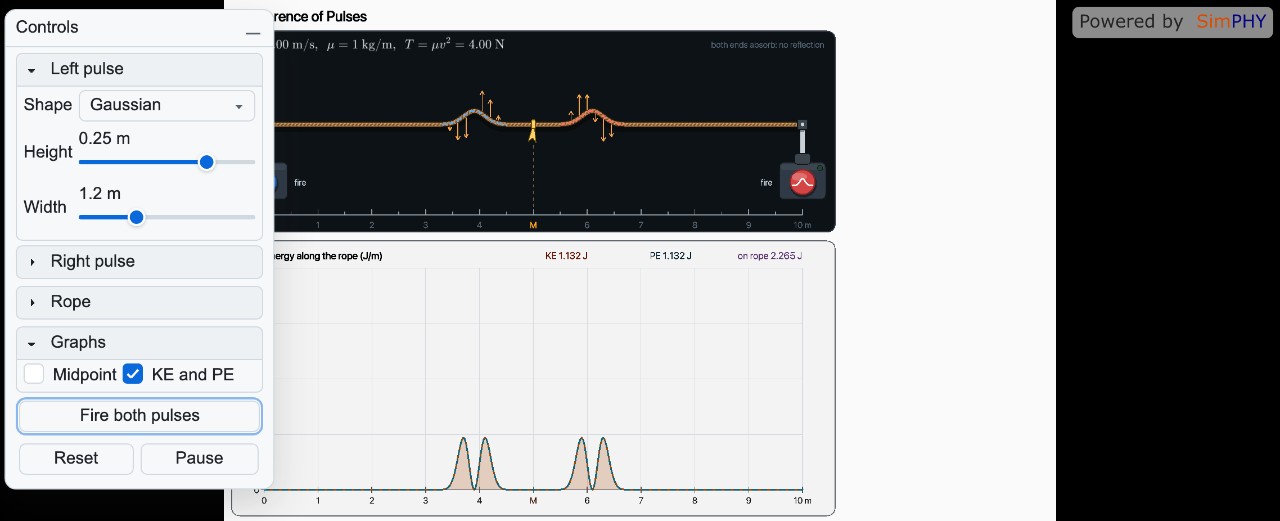
Explore how two opposite‑direction pulses on a rope superpose, using s...
 Free
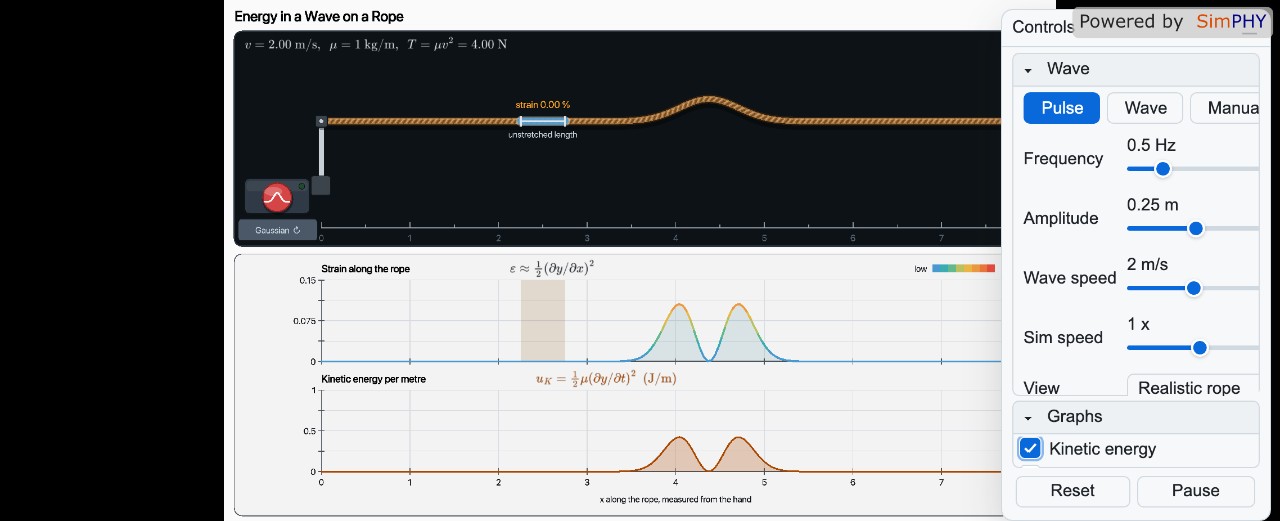
Explore how wave speed, frequency and amplitude affect strain and tota...
 Free
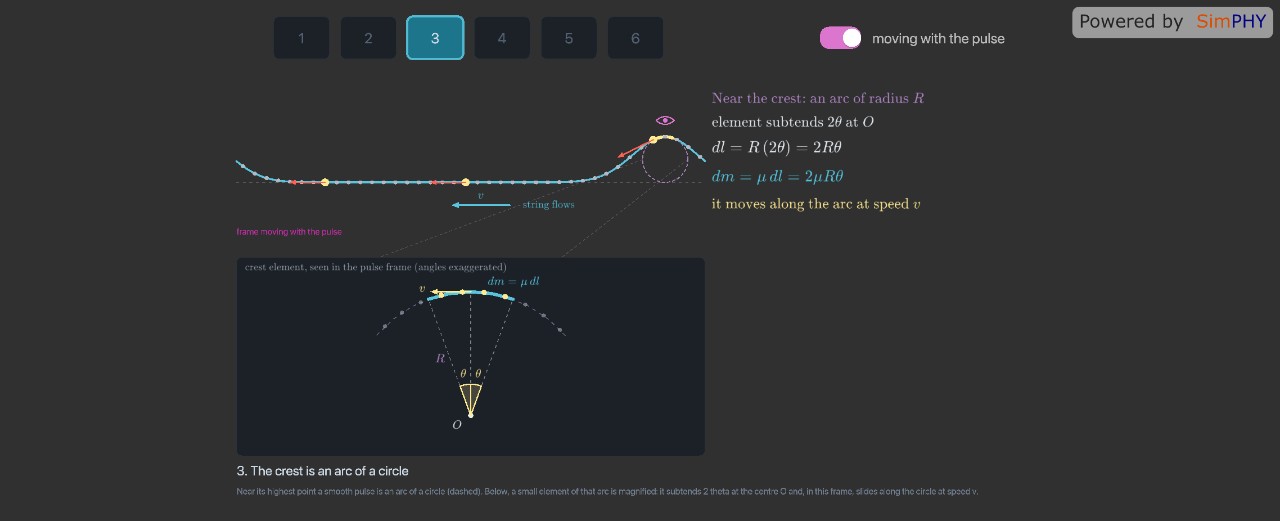
Derive the wave speed v = √(T/μ) on a stretched string, switching betw...