 Free
Resonance Demonstration
Waves & OscillationsExplore standing wave formation and resonance in a rope with free or f...
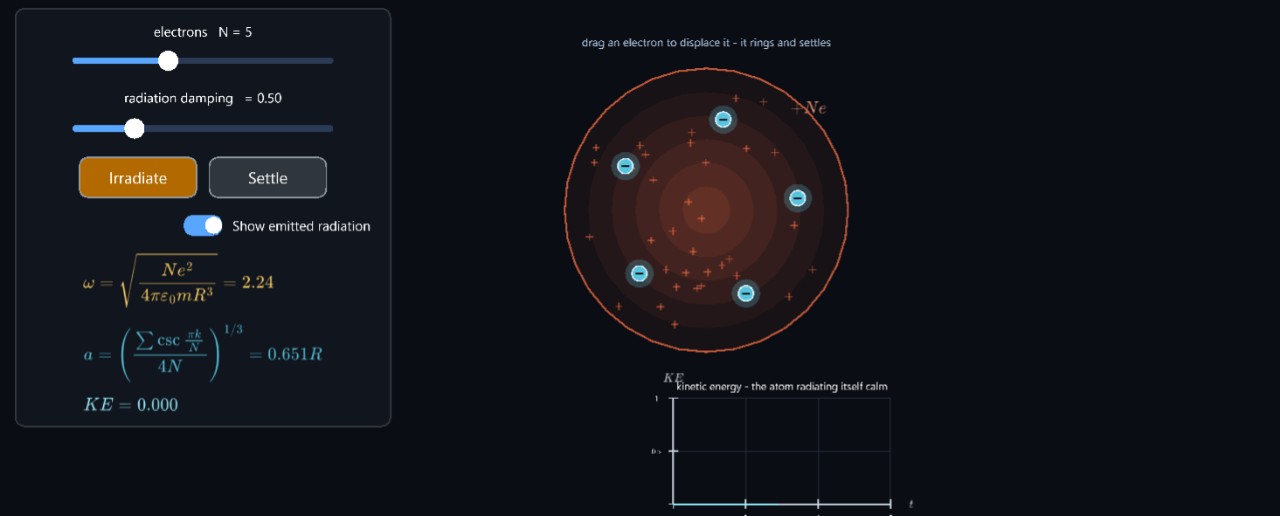
Explore electron dynamics in Thomson’s plum‑pudding atom, adjusting electron count, damping and radiation.
Thomson’s plum‑pudding atom treats the atom as a uniformly charged sphere in which the enclosed positive charge grows with the cube of the radius. Inside this sphere the electric field increases linearly with distance, giving each electron a restoring force that follows Hooke’s law. The result is simple harmonic motion at a single frequency ω = √(Ne²/4πɛ₀mR³). Electrons also repel each other via the usual 1/d² Coulomb force, so the overall dynamics are a balance of a linear inward pull and mutual repulsion.
Students can set the number of electrons (N = 1–12), toggle radiation damping, and use the Irradiate button to launch a visible wave train that kicks the electrons. The Settle control lets the system relax, and a toggle shows emitted radiation. Electrons are draggable, allowing learners to displace a single electron and watch it oscillate and eventually settle into stable ring configurations.
Through this simulation students see how a uniform charge distribution creates a harmonic restoring force, explore the interplay of electrostatic attraction and repulsion, observe radiation damping effects, and understand why the Thomson model predicts a single spectral line, linking atomic models to observable spectra.
Free
Explore standing wave formation and resonance in a rope with free or f...
 Free
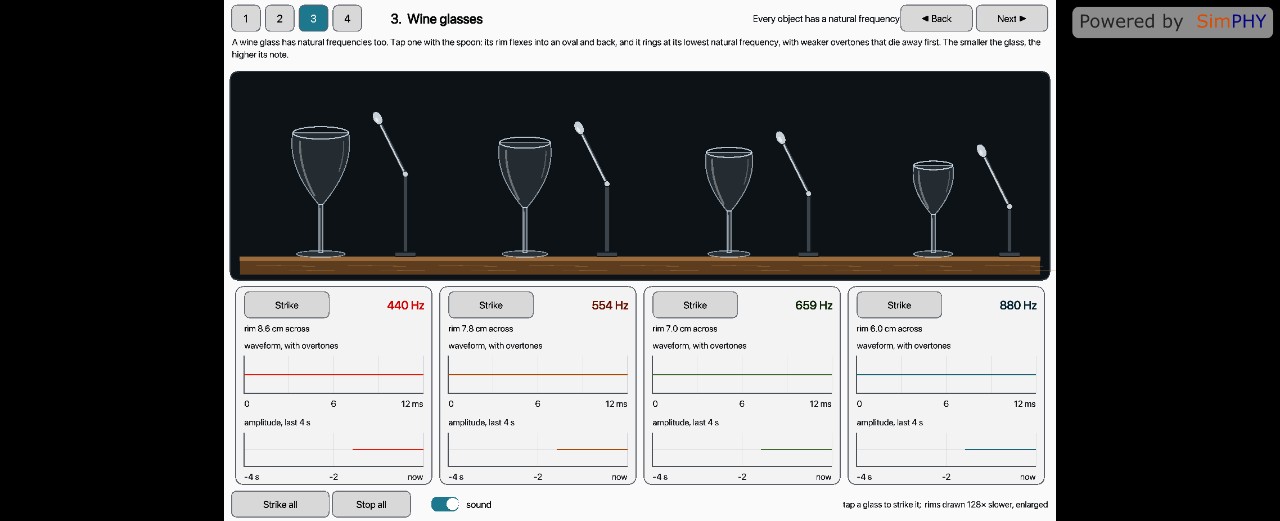
Explore how objects vibrate at their natural frequencies, from springs...
 Free
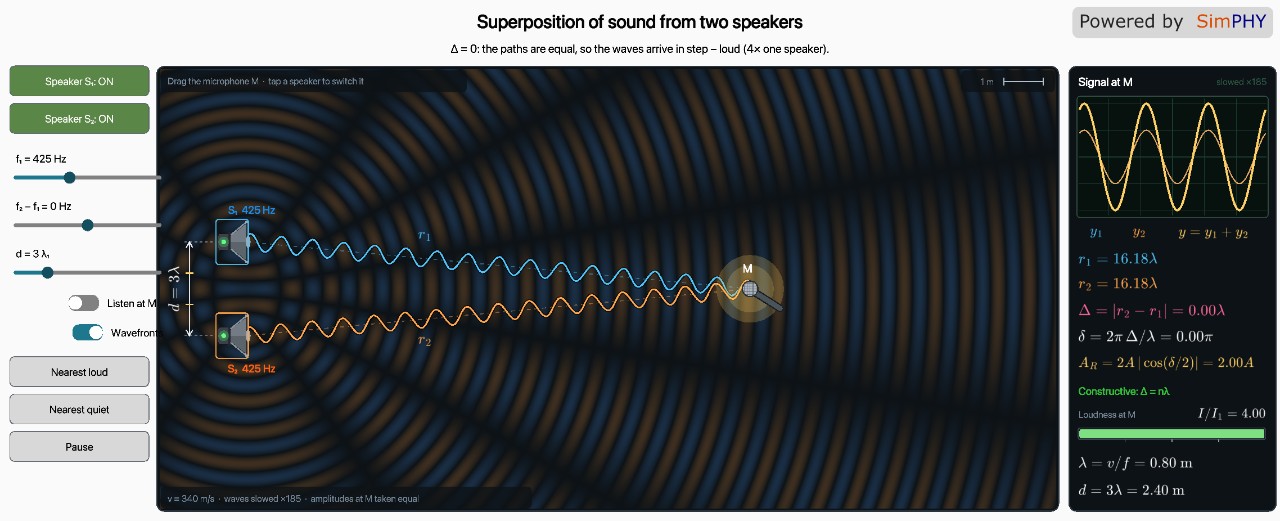
Explore interference and beats from two speakers by adjusting frequenc...
 Free
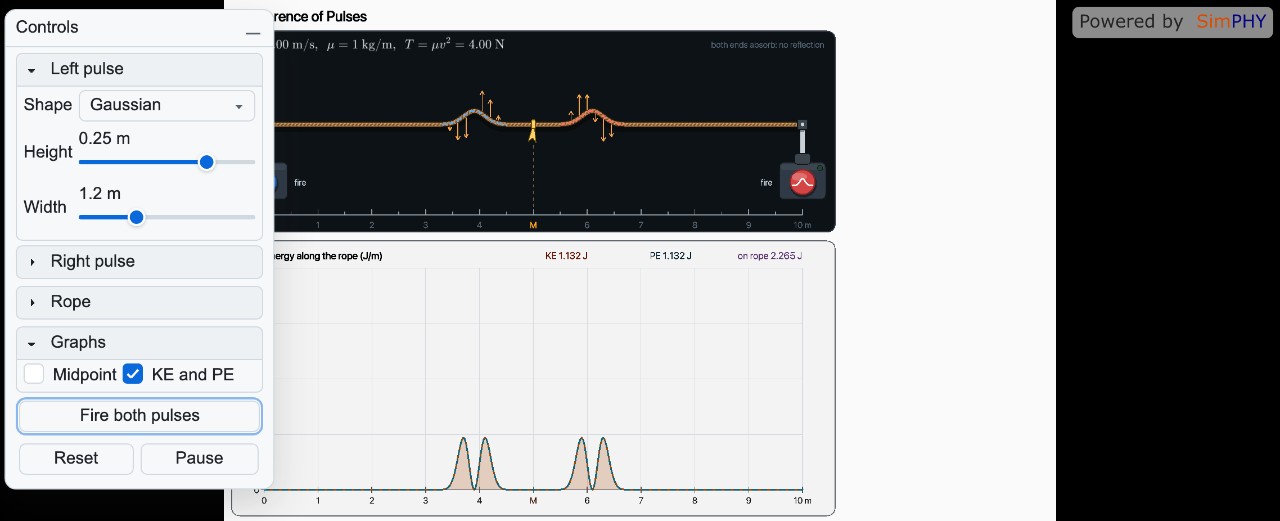
Explore how two opposite‑direction pulses on a rope superpose, using s...
 Free
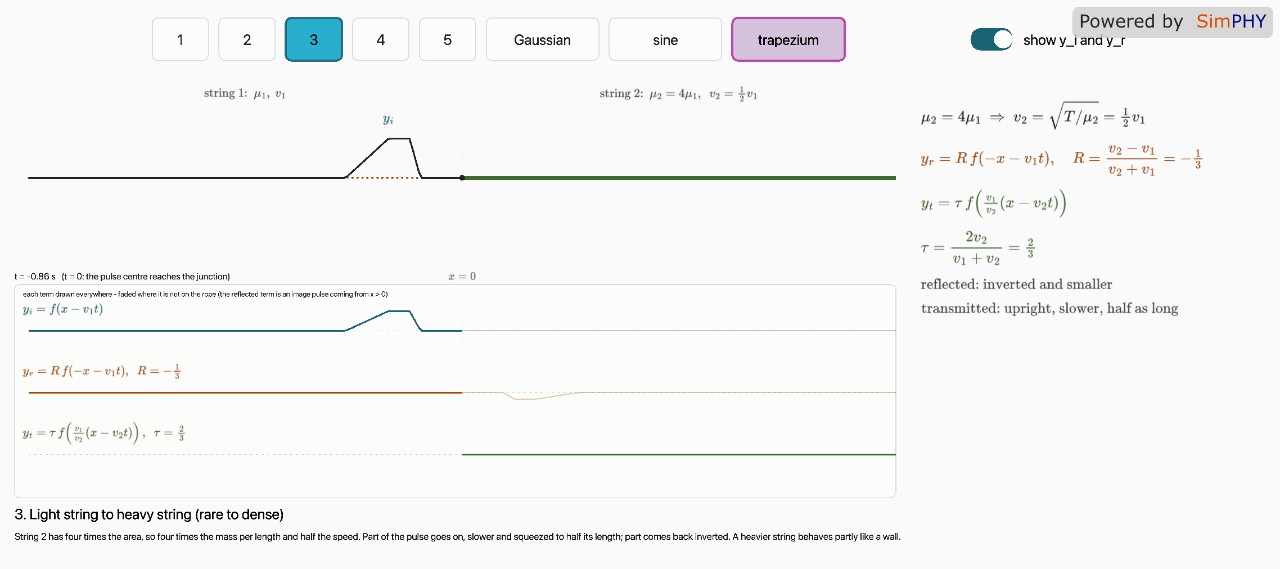
Explore pulse reflection and transmission at fixed, free, and joint st...
 Free
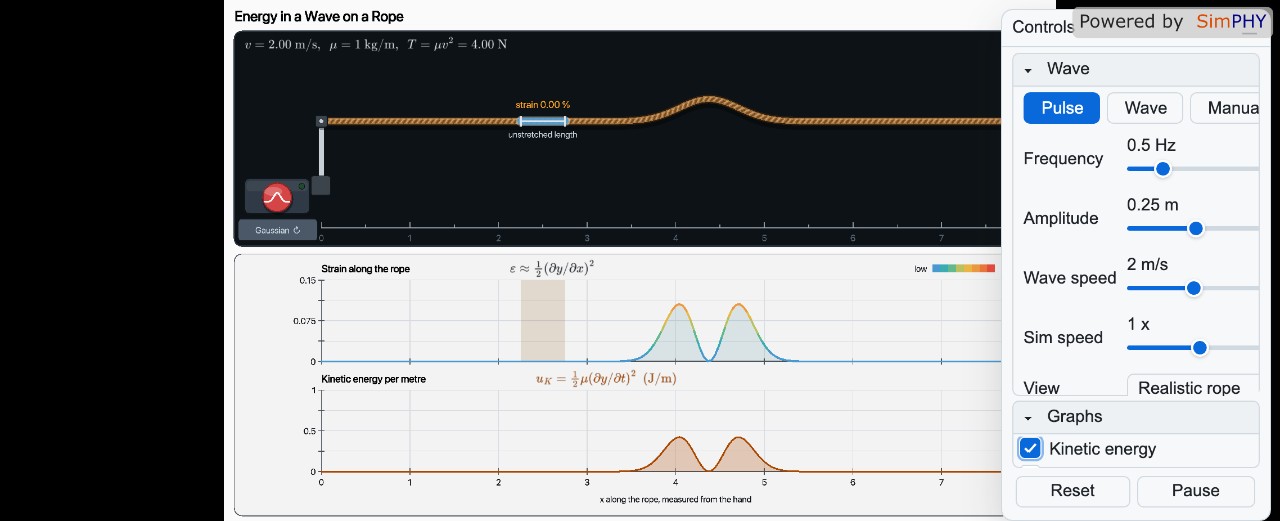
Explore how wave speed, frequency and amplitude affect strain and tota...