 Free
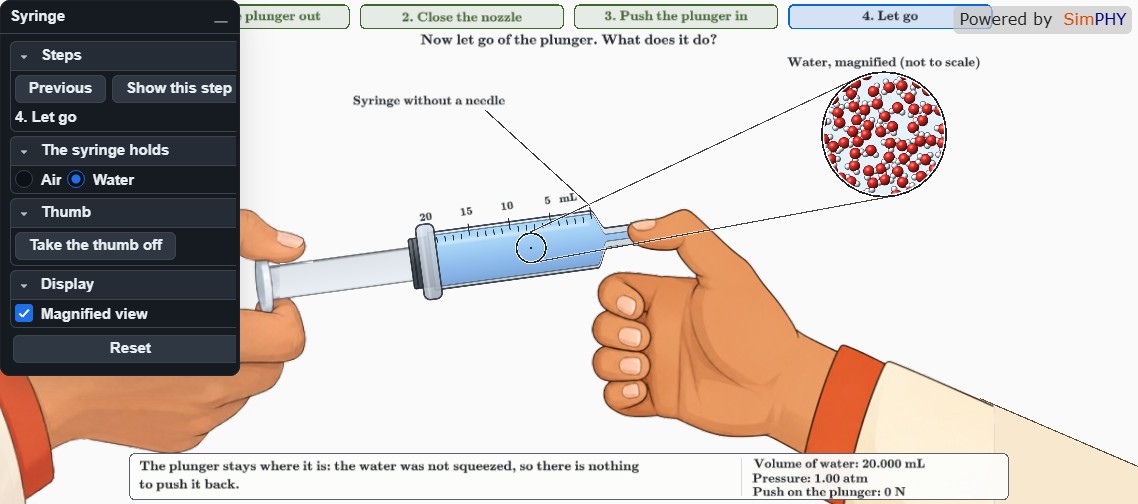
Compressing Air and Water in a Syringe
Fluid MechanicsPull the plunger, seal the tip, and see air compress while water remai...
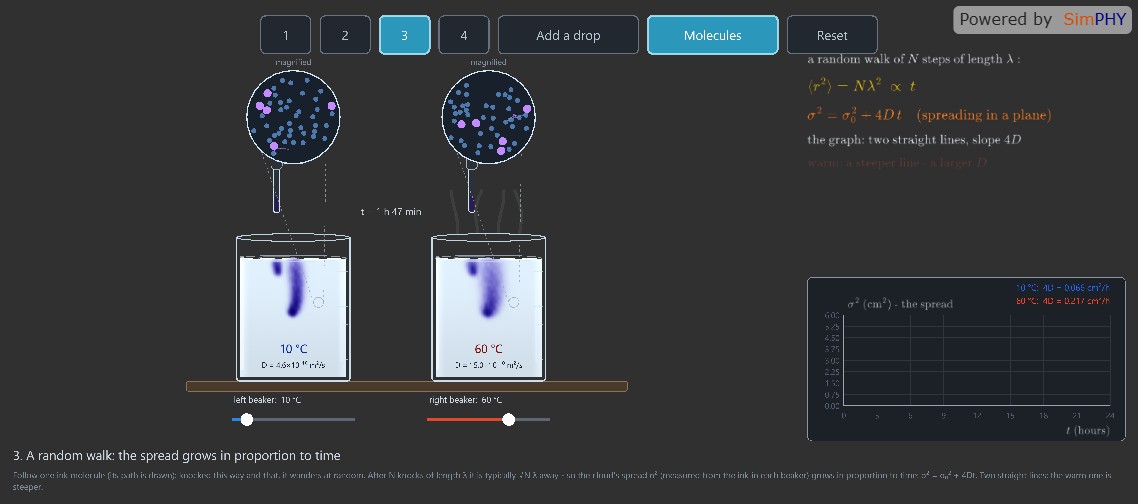
Compare ink spreading in cold versus warm water, observing significantly faster diffusion as temperature…
The simulation visualises how a drop of ink spreads in two beakers of water held at different temperatures. The underlying physics follows the diffusion equation, with the diffusion coefficient D given by the Stokes‑Einstein relation D = kT / (6π η a). Warmer water lowers viscosity, raising D and causing the ink cloud to expand more quickly.
Students step through four stages using numbered buttons, add extra ink drops, and reset the experiment. Each beaker has an independent temperature slider, and a “Molecules” view magnifies the random‑walk motion of individual particles. Steps 3 and 4 display graphs of the measured spread versus time, illustrating the linear relationship ⟨r²⟩ = 4Dt.
By adjusting temperature and observing the resulting diffusion rates, learners connect molecular speed, viscosity, and macroscopic diffusion. They see how random walks produce a predictable spread and how the diffusion coefficient scales with temperature, reinforcing concepts from thermodynamics and fluid mechanics.
Free
Pull the plunger, seal the tip, and see air compress while water remai...
 Free
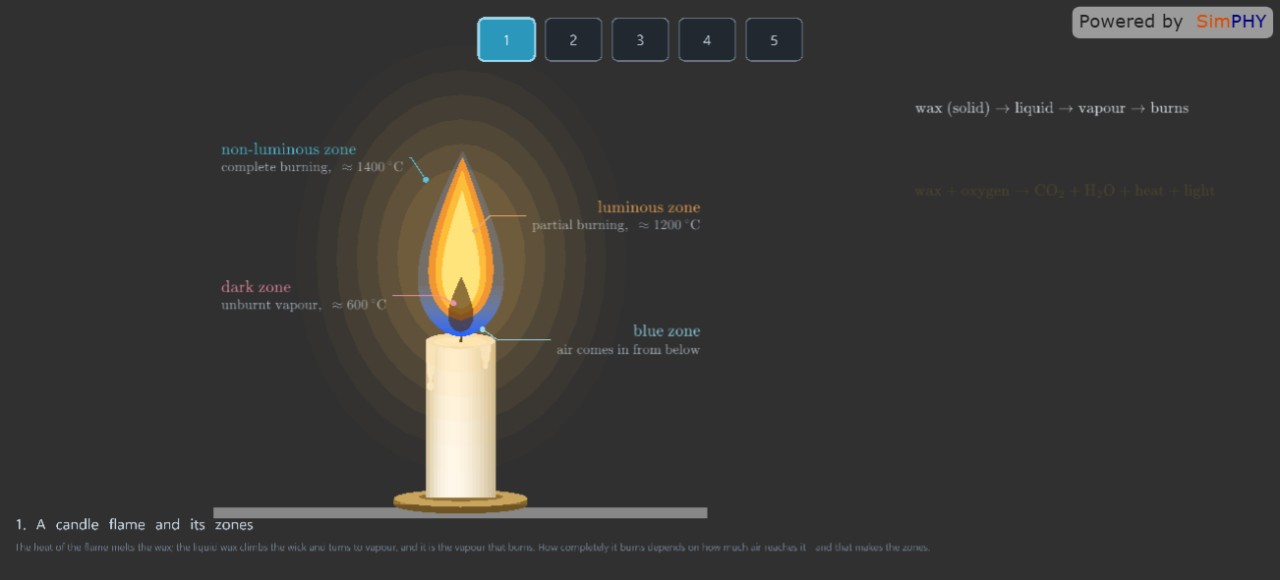
Explore the distinct zones of a candle flame—dark, luminous, outer, an...
 Free
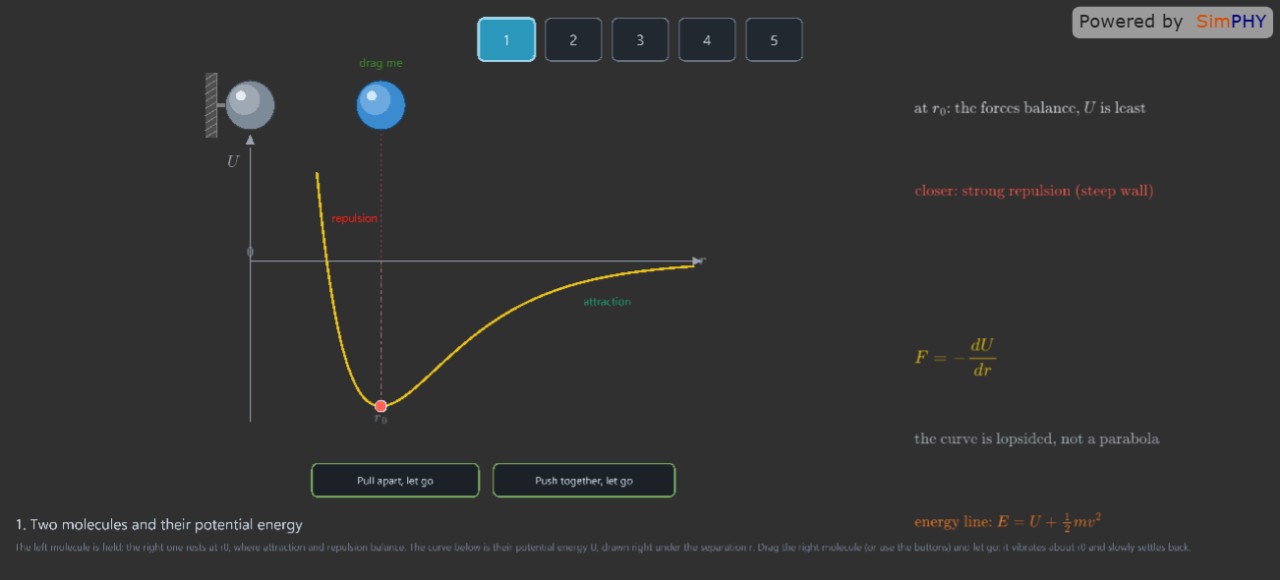
Watch how anharmonic molecular forces cause solids to expand with temp...
 Free
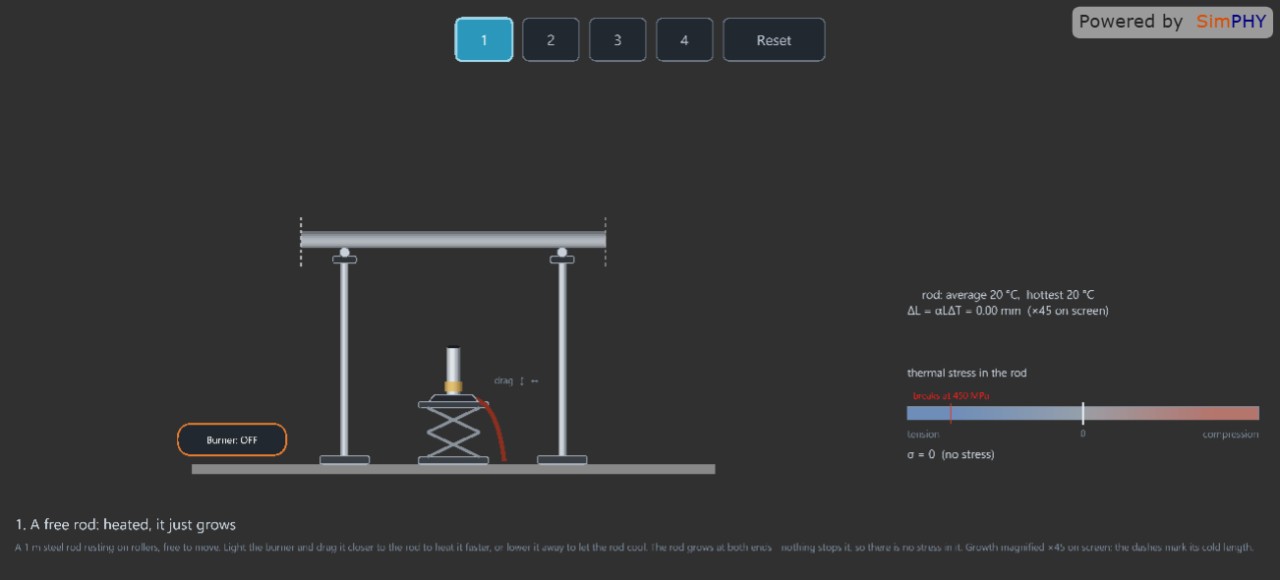
Explore how heating, constraints, and rapid cooling create thermal str...
 Free
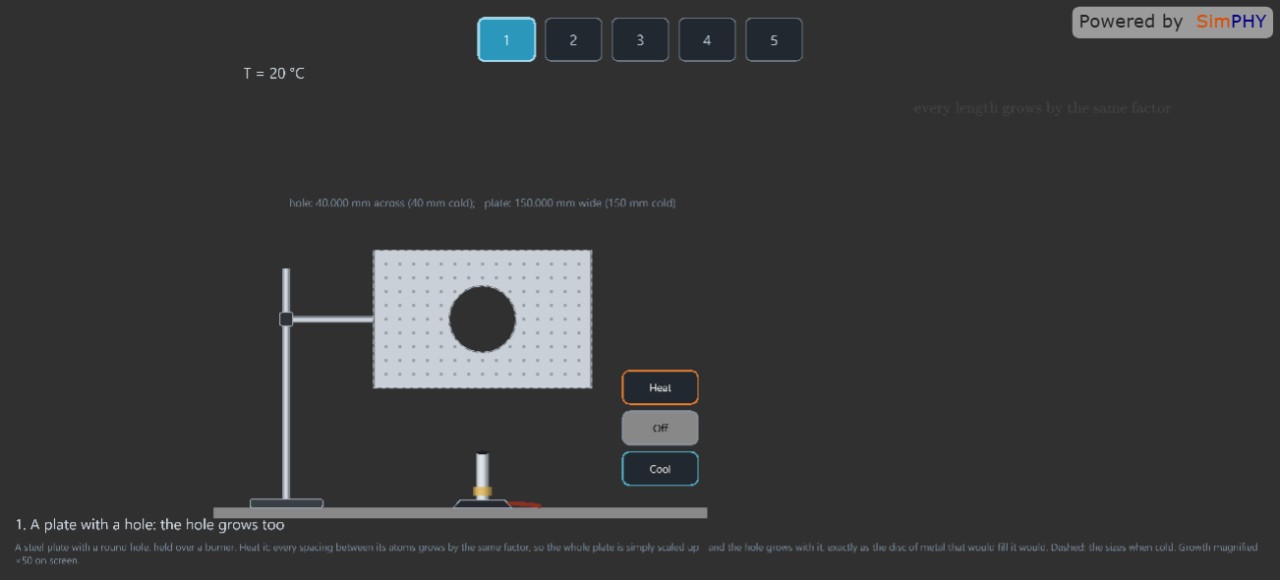
Explore five thermal‑expansion demos: metal plate, glass tube, ball‑ri...
 Free
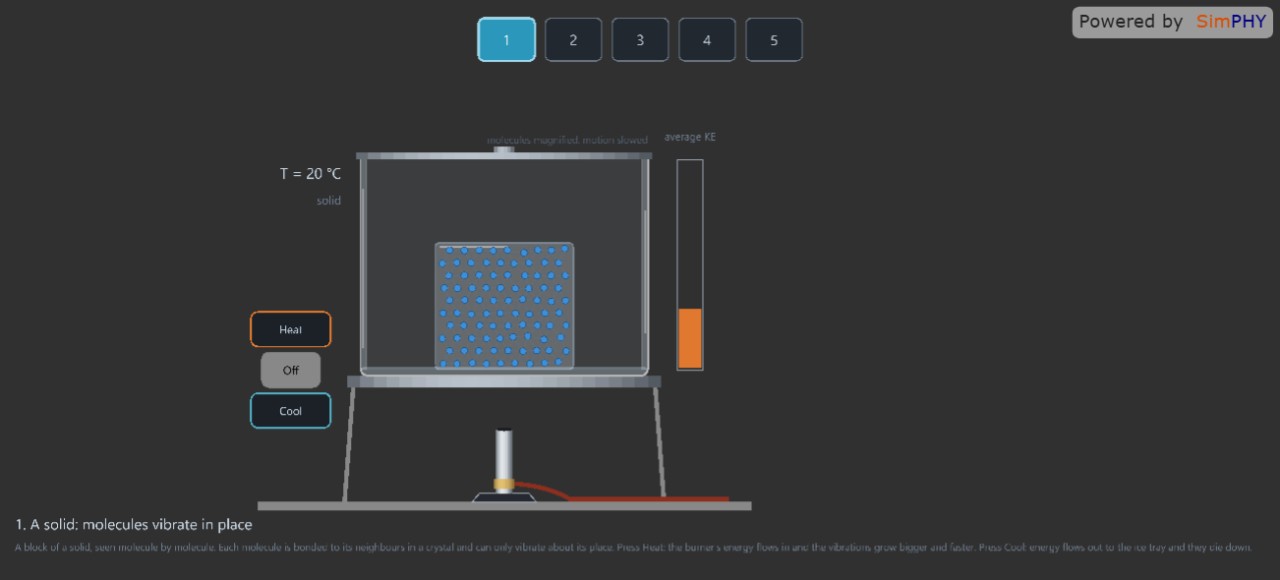
See how heating and cooling change molecular motion in solids, liquids...